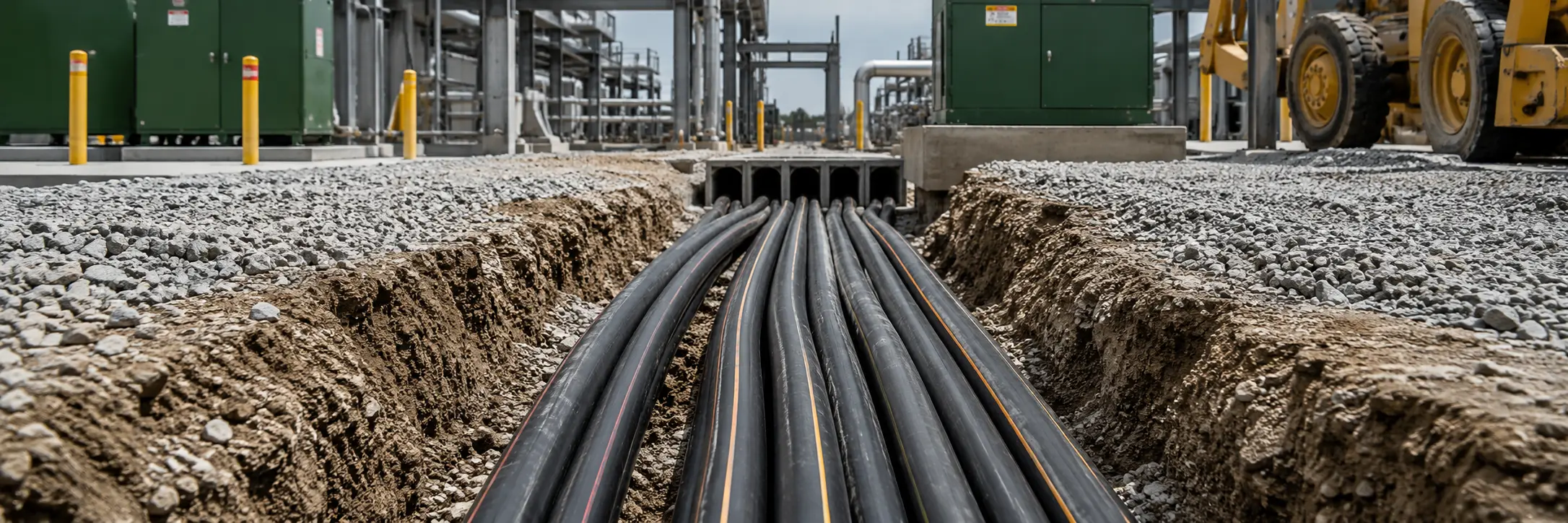
Running cable underground can make an installation look simple. Once the trench is closed, the wiring is protected from traffic, weather, and much of the activity taking place above it. But below grade is not automatically a safe environment for electrical or communication cable.
Underground cable can face persistent moisture, chemicals in the soil, changing temperatures, physical pressure, abrasion, accidental excavation, and other conditions that are very different from those found inside a building. Using a cable simply because it can physically fit inside a trench can create problems that may not become apparent until months or years later.
The important distinction is not whether a cable can be placed underground. It is whether the cable is designed and approved for the conditions it will encounter there.
What Makes an Underground Installation Different?
One of the biggest misconceptions about underground wiring is that covering a cable with soil protects it. In reality, burying a cable introduces a different set of hazards.
Moisture is among the most important. Soil can remain damp for long periods, and underground raceways can also collect water. That means an underground cable may need insulation and jacketing capable of performing continuously in wet conditions rather than simply surviving an occasional exposure to water. Soil composition matters too. Acidity, chemicals, salts, fertilizers, petroleum products, and other contaminants can affect cable materials over time.
Then there are mechanical stresses. Rocks can press against a cable. Soil can shift. Heavy equipment can travel over the installation. Freeze-and-thaw cycles can cause movement. Landscaping work or future excavation can create additional risks. This is why direct burial cable is specifically constructed for underground environments. Depending on the cable, the construction may provide resistance to moisture, impact, soil conditions, and other environmental stresses associated with burial.
Direct Burial Cable and Underground Cable Are Not Always the Same Thing
These terms are sometimes used interchangeably, but they should not automatically be treated as identical. Some cables are specifically rated for direct burial. They can be installed in the ground when the installation meets applicable requirements.
Other cables may be suitable underground only when installed inside an approved raceway or duct. That difference is critical. Putting a cable in conduit does not necessarily eliminate every underground concern. Underground conduit can contain moisture, so the conductors inside still need to be appropriate for the environment.
The safest approach is to select cable based on its actual listing, insulation, jacket construction, voltage rating, temperature rating, and intended application rather than assuming that conduit makes any cable acceptable below grade.
What Happens When the Wrong Cable Is Buried?
Cable failures underground are particularly costly because the problem is hidden. When a cable fails inside an accessible building space, technicians may be able to inspect the run relatively quickly. A buried circuit may require locating the failure, excavating the installation, replacing cable, restoring the trench, and repairing whatever surface was disturbed.
Several problems can develop when cable is poorly matched to an underground application.
Moisture Can Break Down an Inadequate Cable
Water does not have to pour directly onto a conductor to cause trouble. Long-term moisture exposure can gradually affect materials that were not designed for wet environments. Once water reaches vulnerable areas of an electrical system, the result can include insulation deterioration, corrosion, leakage current, intermittent faults, or complete circuit failure.
Underground installations should therefore be treated as potentially wet environments, even when conduit or other protection is being used.
The Cable Jacket Can Deteriorate
The outer jacket provides an important layer of protection, but not every jacket formulation is designed for contact with soil or prolonged outdoor exposure. A cable intended for indoor use may perform perfectly well inside a building but respond differently when exposed to underground moisture, temperature fluctuations, chemicals, or physical pressure. This is one reason selecting cable by electrical characteristics alone is not enough.
Physical Damage May Not Be Immediately Obvious
Cable can also suffer mechanical damage during installation.
Dragging cable across rocks, pulling it improperly through conduit, exceeding recommended pulling tension, or allowing sharp bends can compromise a cable before the trench is even filled.
A damaged jacket might not cause an immediate failure. Instead, it can create an entry point for moisture or weaken the cable enough that problems develop later.
Voltage Drop Can Become a Bigger Issue on Long Runs
Underground cable runs can cover significant distances, especially across commercial properties, industrial facilities, utility installations, campuses, outdoor equipment sites, and infrastructure projects. As conductor length increases, voltage drop becomes increasingly important.
A conductor size that appears sufficient when considering ampacity alone may not provide acceptable performance across a long run. The load, conductor material, circuit voltage, distance, and acceptable voltage drop all need to be considered when sizing the conductors.
Simply selecting a cable because it has the required voltage rating does not necessarily mean it is the right size for the installation.
Where USE-2 and RHW-2 Fit Into Underground Wiring
Cable markings provide important information about where a conductor is designed to operate. For example, Custom Wire & Cable supplies building wire carrying USE-2, RHW-2 and RHH ratings with cross-linked polyethylene insulation. Available products are rated for circuits up to 600 volts and for conductor temperatures up to 90°C in wet or dry locations. The specified products can be installed in raceway, duct, direct burial, and aerial applications when used appropriately.
Those markings matter because they describe capabilities that ordinary building wire may not have. USE-2 is associated with underground service-entrance applications, while RHW-2 identifies conductors designed for use in wet and dry locations under their applicable ratings. Some cable constructions carry multiple designations, increasing the range of applications for which they may be considered.
That does not mean every USE-2, RHW-2, or similarly marked cable is interchangeable. Conductor size, insulation, voltage, installation method, equipment requirements, and applicable electrical codes still determine whether a particular product is appropriate.
Underground Communication Cable Has Its Own Requirements
Power is only part of the underground cable equation. Security systems, controls, audio systems, communications networks, instrumentation, outdoor equipment, and other low-voltage applications may also require underground cable runs.
The same mistake can happen here. An installer may choose a communication cable based primarily on conductor count, shielding, or electrical characteristics while overlooking the environment in which it will operate. A communication cable designed specifically for direct burial may use construction features intended to protect both the cable and the signal underground.
For example, Custom Wire & Cable offers direct burial audio and communication cable using stranded tinned copper conductors, twisted pairs, shielding, and a high-density polyethylene jacket. The listed application includes direct burial and outdoor use, including applications requiring signal isolation. (Custom Cable Corp.)
That illustrates an important point: choosing communication cable for an underground application requires looking at both environmental protection and signal performance.
Direct Burial Does Not Mean Indestructible
A direct burial rating should not be interpreted as permission to install cable without considering the rest of the environment. Cable still needs to be handled properly during installation.
The route should be evaluated for rocks, debris, vehicle traffic, future excavation, drainage, soil conditions, and other factors that could damage the cable. Required burial depths and protection methods can also vary according to the circuit, wiring method, location, and applicable codes.
There are situations where additional mechanical protection may make sense even when the cable itself is suitable for direct burial. For example, a cable crossing beneath an area exposed to vehicle traffic presents different risks than cable installed beneath a landscaped area. An installation near industrial chemicals presents different conditions than an ordinary commercial property. The cable rating is one part of the decision. The environment completes the picture.
Think About What Will Happen Above the Cable Later
An underground cable installation should also account for the future. A location that is open soil today may eventually become a parking area, landscaped bed, driveway, equipment pad, or construction zone. Future work is one of the biggest practical risks to buried utilities.
Excavation equipment, fence posts, landscaping, drainage systems, irrigation work, and additional utility installations can all interfere with existing cable.
Good underground cable planning therefore involves more than choosing the right conductor. It includes considering the route, future accessibility, identification, mechanical protection, and the likelihood that the area will be disturbed later.
Choosing Underground Cable Starts With the Application
There is no single cable that is automatically right for every below-grade installation. Before selecting cable, it helps to identify:
- Whether the circuit carries power, control, audio, data, or another type of signal
- Whether the cable will be directly buried or installed in a raceway
- Whether the location is considered wet
- Required voltage and temperature ratings
- Conductor material and size
- Total run length and possible voltage drop
- Required shielding or signal isolation
- Soil and environmental conditions
- Potential exposure to mechanical damage
- Applicable electrical codes, listings, and project specifications
The answer may be direct burial cable, a USE-2 or RHW-2 construction, a purpose-built direct burial communication cable, or another specialized product. Starting with the environment and application narrows those choices much more effectively than starting with cable size alone.
The Costliest Underground Cable Mistake Often Happens Before the Trench Is Dug
Most underground cable problems are easier to prevent than repair. Once hundreds or thousands of feet of cable have been installed and the site has been restored, discovering that the cable is poorly suited to the environment creates an expensive problem.
The better approach is to evaluate the application before ordering cable. Custom Wire & Cable supplies wire and cable for power, building wiring, communications, industrial equipment, utilities, and demanding outdoor applications. If an underground installation has unusual environmental, electrical, or performance requirements, working through those requirements before selecting the cable can help avoid having to solve the problem after everything is below grade.
Frequently Asked Questions About Underground Cable
Yes. Underground cable can develop problems without any obvious surface warning.
Moisture intrusion, insulation deterioration, corrosion, mechanical pressure, installation damage, or compromised connections can develop below grade. This can result in intermittent faults or declining performance before a complete failure occurs. Because the cable is inaccessible, diagnosing the location and cause of the problem can also be more difficult than troubleshooting an exposed installation.
No. Underground conduit should not be assumed to remain dry.
Moisture can enter underground raceways through condensation, joints, openings, or other pathways. Cable and conductors installed in underground raceways therefore need to be selected for the conditions expected inside that raceway. Conduit provides mechanical protection and routing benefits, but it does not automatically turn an underground installation into a dry location.
Not automatically. The installation depends on the circuits, cable ratings, pathway design, separation requirements, and applicable codes.
Power circuits can also create electromagnetic interference that affects some communication signals. In projects containing both power and communications infrastructure, pathway design should be considered before trenching begins rather than simply placing every available cable in the same route.
Long underground runs can experience enough voltage drop to make a larger conductor desirable or necessary for acceptable performance.
Ampacity determines how much current a conductor can safely carry under specified conditions, but it does not address every performance consideration. Distance increases conductor resistance and voltage drop. Load characteristics, voltage, conductor material, run length, and equipment requirements should therefore be considered along with ampacity when sizing long underground circuits.
Often, yes. Planning for future capacity can prevent another excavation later.
If a site may need additional power, controls, communications, monitoring equipment, or other infrastructure, considering future pathways during the original project can be significantly easier than reopening finished pavement or landscaping. Whether spare conduit or another approach makes sense depends on the project, but future expansion is worth discussing before the trench is closed.