Instrumentation cable often carries signals that are far more sensitive to electrical interference than the power circuits running through the same industrial facility. That makes the choice between shielded and unshielded instrumentation cable more important than simply deciding whether extra protection sounds beneficial.
Shielding can help protect signal integrity, but not every instrumentation circuit requires it. The right choice depends on what signal the cable is carrying, what electrical equipment is nearby, how and where the cable will be installed, and how much interference the system can tolerate. Understanding those conditions can help you determine when shielded instrumentation cable is appropriate and when an unshielded construction may be sufficient.
What Does the Shield in Instrumentation Cable Do?
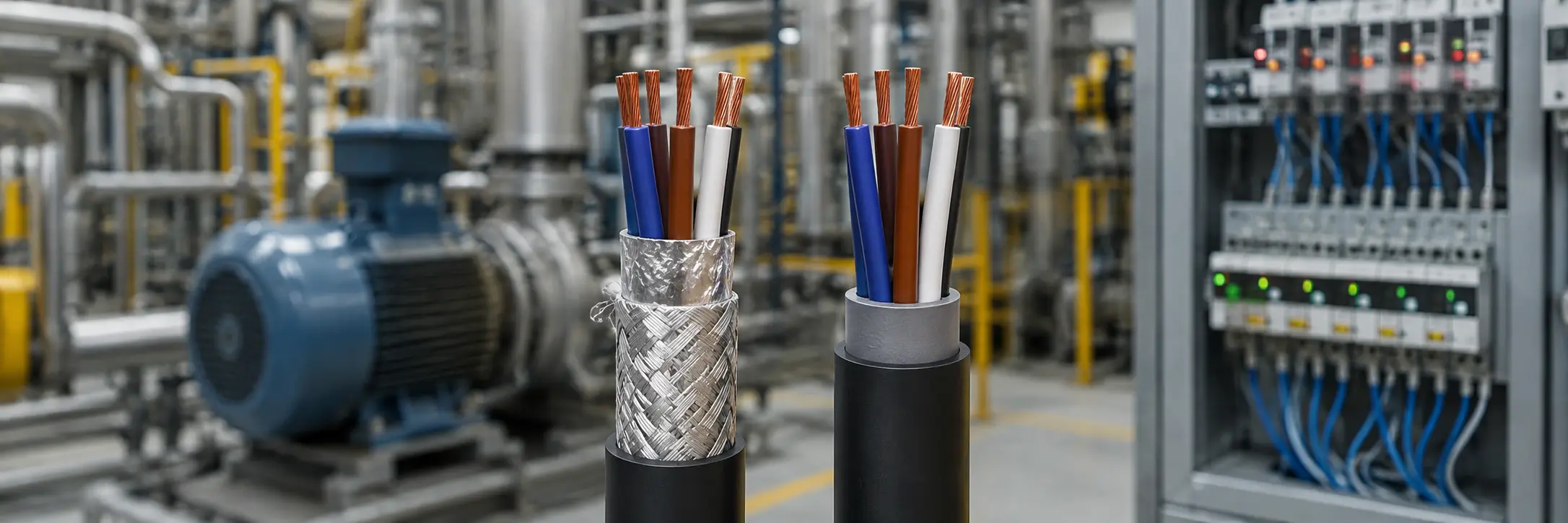
The shield is a conductive layer incorporated into the cable construction to help reduce the effects of electromagnetic interference and radio frequency interference on the signal conductors.
Industrial facilities can contain numerous potential sources of electrical noise. Motors, variable frequency drives, transformers, switching equipment, power conductors and other electrical systems may create electromagnetic fields around nearby wiring.
When instrumentation circuits carry sensitive measurement or monitoring signals through these environments, unwanted electrical noise can distort the signal reaching the receiving equipment.
Shielding creates an additional barrier between those external sources of interference and the conductors carrying the instrumentation signal. It is important, however, to think of shielding as part of the complete cable and system design rather than as an automatic upgrade that every instrumentation circuit needs.
When Is Shielded Instrumentation Cable Usually the Better Choice?
Shielded cable becomes especially important when instrumentation wiring runs through an electrically noisy environment. Consider a manufacturing plant where a low-level sensor signal must travel from process equipment to a control panel while motors, drives and high-current electrical equipment operate nearby. The cable may be carrying a relatively small measurement signal while substantially larger electrical loads are switching on and off around it. In this type of installation, shielding can help prevent surrounding electrical activity from interfering with the signal.
Shielded instrumentation cable is commonly considered when wiring is installed near equipment such as:
- Variable frequency drives
- Large electric motors
- Transformers
- Motor control centers
- High-current power conductors
- Switching equipment
- Industrial machinery
Physical proximity is only one factor. The sensitivity of the signal itself can make shielding important even when the source of interference is not immediately beside the cable.
The Signal Being Transmitted Matters
Not every instrumentation signal responds to electrical noise in the same way. Low-level analog signals used for measurement and process control can be particularly sensitive because relatively small amounts of electrical interference may alter the value received by the control or monitoring system.
For example, a transmitter might be reporting pressure, temperature, flow or another process condition. If interference changes the signal reaching the receiving equipment, the system may interpret that interference as a change in the process itself.
The consequences depend on the application. In some systems, small variations may have little practical effect. In others, accurate readings are essential for maintaining process stability, equipment performance or reliable monitoring. This is why cable selection should start with the requirements of the circuit rather than simply with the environment surrounding the cable.
Cable Routing Can Change the Shielding Decision
Two otherwise identical instrumentation circuits can require different cable constructions depending on how the wiring is routed. A cable running through an area separated from major electrical equipment may face relatively little interference. The same circuit routed alongside power wiring or through a densely populated industrial cable tray may experience a much different electrical environment. Ideally, instrumentation and power wiring are routed with appropriate separation when the installation permits it. In existing facilities, however, routing options may be limited.
Long cable runs can also increase the opportunity for unwanted interference to affect a signal, particularly when the route passes through several electrically active areas. For that reason, the question should not simply be, “Is this an industrial application?” A better question is, “What electrical conditions will this particular cable encounter along its entire route?”
When Can Unshielded Instrumentation Cable Be Appropriate?
Unshielded cable is not simply a lower-grade alternative to shielded cable. There are applications where shielding may offer little practical benefit. If the instrumentation circuit carries a signal that is relatively tolerant of electrical noise and the cable can be routed away from major interference sources, an unshielded construction may meet the project’s requirements.
Shorter cable runs through controlled environments may also reduce the need for additional shielding. The equipment manufacturer’s requirements, engineering specifications and applicable installation standards should always take priority. If the project specifically calls for shielded instrumentation cable, substituting an unshielded construction simply because the surrounding environment appears quiet is not appropriate. Similarly, adding shielding without considering the overall system does not automatically improve performance.
Overall Shielding Versus Individual and Overall Shielding
For multi-pair or multi-triad instrumentation cables, shielding can be applied in different ways. An overall shield surrounds the cable assembly and provides protection against interference affecting the cable as a whole.
Some constructions provide individual shielding around separate pairs or triads in addition to an overall shield. This type of construction can provide additional isolation between circuits within the same cable while also helping protect the complete cable from outside interference.
Individual and overall shield constructions can be particularly useful when multiple sensitive signals share a common cable and minimizing interaction between those circuits is important.
Custom Cable Corp. offers instrumentation cable configurations including single-pair, multi-pair, single-triad and multi-triad constructions as well as individual and overall shield options.
Shielding Does Not Replace Proper Installation
Selecting shielded cable is only one part of controlling interference. Shielding must be incorporated into an appropriately designed system and installed according to the requirements of the equipment, cable construction and project specification. Poor cable routing or improper shield termination can undermine the reason shielded cable was chosen in the first place.
Signal cables should also be installed with appropriate consideration for nearby power wiring and potential sources of electromagnetic interference. The goal is not simply to purchase a cable containing a shield. It is to maintain the integrity of the signal from the field device to the equipment receiving that signal.
Shielded Instrumentation Cable Versus Shielded Control Cable
Instrumentation and control circuits frequently exist beside one another in industrial systems, but the terms are not interchangeable. Instrumentation cable is generally associated with signal transmission, measurement, monitoring and process instrumentation. Control cable may carry signals or power associated with relays, switches, machinery and equipment control.
Both can be available in shielded constructions because either type of circuit may encounter electrical interference. The function of the circuit should therefore be established before cable selection begins. Choosing cable solely because it is described as “shielded” does not confirm that its other electrical, mechanical and environmental characteristics are appropriate for the application.
Other Cable Requirements Still Matter
Electrical noise is only one part of selecting instrumentation cable. Once you determine whether shielding is necessary, the cable still needs to match the rest of the installation. Depending on the project, specifications may include conductor size, number of pairs or triads, voltage rating, insulation and jacket materials, temperature rating and the required installation method.
Environmental conditions can also affect the choice. A cable installed in a dry indoor raceway may require a different construction from one exposed to moisture, chemicals, low temperatures or direct burial conditions. Shielding should therefore be treated as one selection criterion within a much larger set of cable requirements.
How to Decide Between Shielded and Unshielded Instrumentation Cable
A useful starting point is to evaluate three things together: the signal, the environment and the installation. First, determine how sensitive the circuit is to unwanted electrical noise. Then identify motors, drives, power circuits and other possible interference sources along the planned cable route. Finally, confirm the project’s cable and equipment specifications. If those factors indicate a meaningful risk of interference, shielded instrumentation cable may provide the signal protection the application requires.
If the circuit is less sensitive, the route is electrically quiet and project requirements permit it, an unshielded construction may be suitable.
When the correct construction is unclear, Custom Cable Corp. can help identify instrumentation cable options based on the signal application, shielding requirements, conductor configuration, voltage, environment and installation method.
Frequently Asked Questions
Sometimes, but separation alone does not determine whether shielding is necessary.
Increasing distance from power conductors and electrically noisy equipment can reduce exposure to electromagnetic interference. However, cable routing is only one part of the decision. Signal sensitivity, the strength and type of nearby interference, cable-run length, equipment requirements and project specifications also matter. A circuit carrying a highly sensitive signal may still require shielded instrumentation cable even when reasonable separation from power wiring is maintained.
Yes. Electrical noise can sometimes appear as unwanted variation in the signal received by monitoring or control equipment.
Instrumentation systems rely on the receiving device accurately interpreting the signal produced by a sensor or transmitter. When electromagnetic interference affects that signal, the resulting reading may fluctuate or differ from the intended value. The effect can range from minor instability to a more significant measurement problem depending on the signal type, equipment and level of interference. Shielding is one method used to reduce this risk in electrically noisy installations.
No. Cable length can increase interference concerns, but it does not automatically make shielding necessary.
A longer cable provides more opportunity for the circuit to pass near electrical equipment or through areas containing electromagnetic noise. That can make shielding more important in some installations. However, the correct decision also depends on signal type, routing, nearby equipment, cable construction and engineering requirements. A long run through an electrically quiet environment may present less interference risk than a much shorter run beside a variable frequency drive or large motor.
It may be worthwhile if the electrical environment around existing instrumentation circuits has changed.
A cable installation that operated reliably when originally designed may encounter different interference conditions after new motors, drives, power conductors or other electrical equipment are installed nearby. If unexplained signal instability begins after plant modifications, cable routing and interference exposure are among the factors worth evaluating. This does not necessarily mean the cable must be replaced, but changes to the surrounding electrical environment can affect circuits that previously had little exposure to noise.
No. The best cable is the construction that meets the electrical, environmental and installation requirements of the application.
More shielding is not automatically better for every circuit. Individual and overall shields can provide valuable protection for sensitive multi-pair or multi-triad systems, but some applications may only require an overall shield, while others may not need shielding at all. Conductor configuration, voltage, insulation, jacket material, temperature, installation rating and project specifications remain equally important. Cable selection should match the complete application rather than maximizing a single feature.