A cable specification error in a data center does not always look like a major problem at first. Sometimes it is a jacket rating that gets overlooked. Sometimes the cable technically meets an electrical requirement but will not work in the planned pathway. Sometimes a substitute product appears close enough on paper until someone notices that an approval, fire rating or construction detail does not match the project. By the time that happens, thousands of feet of cable may already be on site.
In an environment where uptime, scheduling and coordination matter so much, small cable decisions can create outsized problems. The best time to catch them is before the reels arrive. Here are some of the most common ways data center cable specifications can go wrong.
The Cable Is Correct for the Signal, but Wrong for the Space
One of the easiest mistakes to make is choosing cable based only on what it needs to carry. That is only half the decision.
A cable carrying the correct data signal or electrical load may still be inappropriate for the space where it will be installed. Data center cabling may pass through:
- Plenum spaces
- Risers
- Cable trays
- Conduit
- Equipment rooms
- Raised-floor areas
- Outdoor pathways
- Racks and cabinets
Each environment can introduce different requirements. This is why a cable that works perfectly well in one section of a facility may not be suitable several rooms away. The cable route needs to be understood before the product is finalized.
A Fire Rating Gets Treated Like a Minor Detail
Fire and smoke ratings are one area where assumptions can create expensive rework. For example, a contractor may know that a communications cable needs to travel above a ceiling and automatically assume that a certain cable construction is acceptable. But not every above-ceiling space is the same.
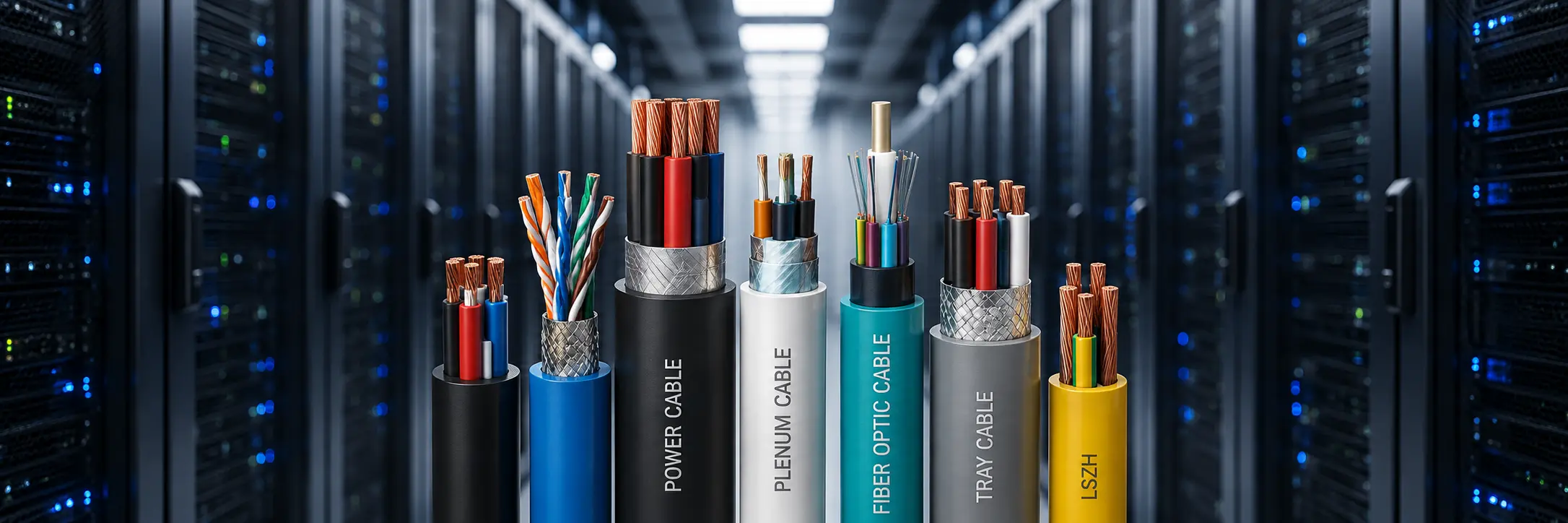
If the space is used for environmental air, the cable may need a specific plenum rating. Riser applications have different considerations. Low smoke zero halogen cable addresses another set of performance characteristics. These terms are related to cable safety, but they are not interchangeable.
A mistake here can become more than a purchasing inconvenience. It can result in failed inspections, replacement cable orders and schedule delays.
The Substitute Looks Close Enough
Substitutions are common on large projects. A specified product may be unavailable, a lead time may be too long or another manufacturer may offer what appears to be an equivalent product. That is where problems can start.
Two cables can have similar descriptions while differing in:
- Voltage rating
- Temperature rating
- Insulation
- Jacket material
- Flame rating
- Shielding
- Conductor construction
- Listings and approvals
- Wet-location suitability
- Overall diameter
That difference may be insignificant in one application and critical in another. The safest approach is to compare the actual specification rather than relying on a product name that sounds similar.
The Cable Works Electrically but Creates an Installation Problem
Electrical performance is not the only thing that determines whether a cable will work in a data center. Physical dimensions matter too.
A cable may meet every electrical requirement and still cause problems because of its diameter, bend radius, weight or pulling characteristics. This becomes especially important in data centers because so many systems compete for limited pathway space. Think about what can accumulate around a single area: Network cabling. Fiber. Power. Security. Building controls. Monitoring systems. Redundant infrastructure. Now add future expansion.
A tray or pathway that looked generous during design can become crowded surprisingly quickly. If cable diameter and bend radius were not considered early, installers may discover that a planned route is much tighter than expected.
The Fiber Is Right for Today but Not Tomorrow
Fiber optic cable is central to modern data center infrastructure, but specifying fiber should not be based only on today’s network. Data centers change constantly.
Bandwidth requirements grow. Equipment is replaced. Additional connections are added. New racks come online. A fiber installation that meets the immediate requirement may become a limitation sooner than expected if future expansion was never part of the discussion. The construction of the fiber also matters.
Depending on the route, a project may call for indoor, outdoor, riser, plenum, armored or other fiber configurations. The question is not simply whether the project needs fiber optic cable. The real question is what that fiber needs to do during its entire route through the facility.
Power and Data Paths Were Planned Separately
Data centers rely on enormous amounts of both power and communications infrastructure. Those systems cannot always be planned independently.
Power circuits can introduce electromagnetic interference that may affect certain signal circuits. Different systems may also have pathway and separation requirements that need to be coordinated.
Shielded cable can help in some applications, but shielding should not be treated as a substitute for good pathway planning. The better approach is to look at the facility as a whole. Where will power run? Where will communications cable run? Where will those pathways cross? Where will they share congested areas?
Those questions are much easier to answer during planning than after trays and equipment have already been installed.
Tray Cable Gets Specified Too Broadly
“Tray cable” sounds like a specific product. It is not. There are many types of tray cable designed for different applications, including power, control and instrumentation.
If a project specification simply calls for tray cable without enough detail, important requirements can get missed. The purchasing team may still need to confirm:
- Voltage
- Conductor size
- Conductor count
- Shielding
- Insulation
- Jacket
- Temperature rating
- Applicable listings
- Wet or dry location requirements
- Whether the cable transitions out of the tray
The installation method helps define the cable, but it does not replace the rest of the specification.
There Is No Room Left for the Next Expansion
This is one of the easiest problems to overlook because nothing appears wrong on day one. The system works. The cable fits. The trays are full. Then the facility grows. New equipment requires additional power and data connections. More fiber needs to be installed. Another monitoring system is added. Suddenly there is no easy path for the new cable.
Data centers are built around continuous change, which makes pathway capacity an important part of long-term planning. Leaving reasonable space for future cabling can make later upgrades much easier and reduce the amount of disruption required around active systems. That does not necessarily mean installing spare cable everywhere. It means avoiding an infrastructure design that has no room to evolve.
Cable Procurement Starts Too Late
Some cable problems are really scheduling problems. Large data center projects may require precise constructions, substantial quantities or products with specific approvals.
If procurement starts only when installation is approaching, the number of available options can shrink quickly. A better request for quotation includes more than a general cable description. Ideally, it includes details such as:
- Cable type
- Conductor size and count
- Fiber requirements
- Voltage
- Insulation
- Jacket
- Shielding
- Fire rating
- Required approvals
- Total footage
- Reel requirements
- Delivery schedule
- Approved manufacturers or substitution requirements
The more complete the information, the easier it is to identify conflicts before they become job-site problems.
The Most Expensive Cable Problem May Be the One Nobody Notices Early
Most data center cable mistakes are not caused by someone ignoring an obvious requirement. They happen because one detail was assumed. The cable looked equivalent. The route changed. A rating was overlooked. A pathway filled faster than expected. An installation requirement never made it from the engineering documents to the purchasing team.
That is why cable sourcing for data centers works best when the specification, installation environment and project schedule are considered together.
Custom Cable Corp. supplies wire and cable for data centers and critical infrastructure, including products for data transmission, fiber networks, power distribution, cable tray installations and demanding commercial environments.
When sourcing cable for a data center project, providing the full specification and explaining how and where the cable will be installed can help identify potential mismatches before they reach the job site.
Frequently Asked Questions About Data Center Cabling Problems
Yes. A cable may perform correctly from an electrical or communications standpoint but still fail to meet the requirements for the space where it is installed.
Fire, smoke, plenum, riser and other ratings can affect whether a cable is appropriate for a particular pathway. Because requirements can vary by installation, those details should be verified before cable is ordered rather than after installation begins.
Data centers often concentrate large numbers of cable runs into limited pathway space.
Even a relatively small difference in cable diameter can become significant when hundreds of runs share trays, conduits or rack entrances. Diameter can affect tray fill, bend radius, pulling difficulty and the amount of capacity left for future expansion.
No. Products that appear equivalent may have important differences in construction, ratings or approvals.
Before substituting one cable for another, compare the actual specifications, including conductor construction, insulation, jacket, voltage, temperature rating, shielding, flame rating and required listings. Project approval requirements should also be checked before a substitution is made.
Future pathway capacity is easy to overlook because it does not cause a problem during the initial installation.
A facility may operate perfectly at first, but future equipment additions can require more power, fiber and communications cabling. If pathways are already at capacity, even a routine expansion can become much more difficult.
Provide as much of the original cable specification as possible, along with information about the installation environment.
Useful details include conductor or fiber requirements, voltage, insulation and jacket materials, shielding, fire rating, approvals, footage, reel requirements and schedule. It is also helpful to identify whether the cable will run through tray, conduit, plenum spaces, risers, outdoor areas or other specialized environments.