How Much Voltage Drop Is Too Much in a Direct-Burial Cable Run?

A cable can have sufficient ampacity for a load and still be a poor choice for a long underground run. The reason is voltage drop. Every conductor has resistance. As current travels through the conductor, some voltage is lost along the way. The farther the electrical equipment is from the source, the more important that […]
When Should You Use Irradiated PVC Hook-Up Wire Instead of Standard PVC Hook-Up Wire?

PVC is one of the most familiar insulation materials used on hook-up wire, but not every PVC insulation performs the same way. When equipment has limited internal space, elevated operating temperatures, demanding assembly conditions or very specific UL requirements, the way the PVC insulation is manufactured can make a meaningful difference. One option is irradiated […]
When Do You Need Shielded Instrumentation Cable Instead of Unshielded Cable?

Instrumentation cable often carries signals that are far more sensitive to electrical interference than the power circuits running through the same industrial facility. That makes the choice between shielded and unshielded instrumentation cable more important than simply deciding whether extra protection sounds beneficial. Shielding can help protect signal integrity, but not every instrumentation circuit requires […]
Data Center Cable Specification Mistakes to Avoid

A cable specification error in a data center does not always look like a major problem at first. Sometimes it is a jacket rating that gets overlooked. Sometimes the cable technically meets an electrical requirement but will not work in the planned pathway. Sometimes a substitute product appears close enough on paper until someone notices […]
Cable in the Real World: Heat, Moisture, Oil, Abrasion, and Everything the Spec Sheet Does Not Explain Clearly

A wire or cable spec sheet can tell you a lot. It can list the voltage rating, temperature rating, conductor size, insulation type, jacket material, approvals, dimensions, and weight. Those details matter. They help engineers, purchasing teams, contractors, and maintenance departments narrow down the right product. But a spec sheet does not always explain what […]
The Cable Mistake That Can Stall an Entire Job Site

On a busy job site, cable usually is not the loudest problem. It is not the crane, the crew schedule, the weather, or the inspection deadline. It is usually sitting on a pallet, coiled up, waiting to be pulled, buried, hung, connected, or routed through a building. It looks simple enough. Until it is not […]
When Flexible Power Cable Has to Survive the Job, Not Just Fit the Plug
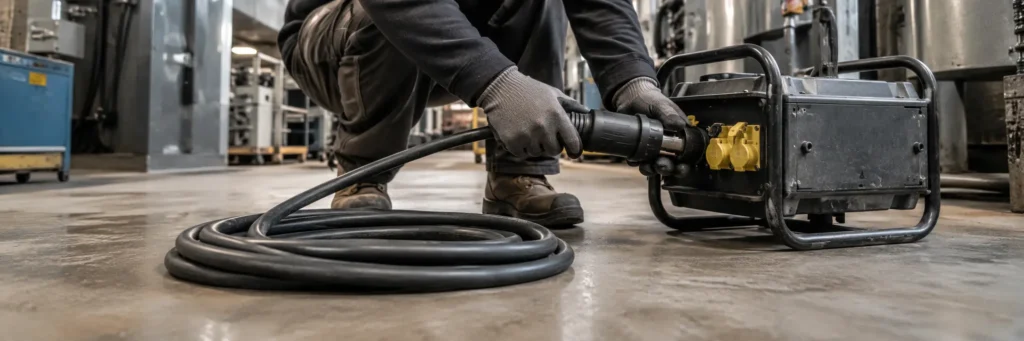
Flexible power cable is easy to underestimate. On paper, it can look like a simple order. A buyer needs a certain gauge, a certain conductor count, a certain voltage rating, and a certain length. Done. But in the field, the cable does not live on paper. It gets dragged across concrete. It gets pulled around […]
MC Cable vs. Interlocked Armored Cable: What Is the Difference?

When people search for MC cable, they are often looking for a cable that can protect conductors without requiring a separate conduit system. That makes sense. In commercial, industrial, utility, and equipment wiring applications, labor time, mechanical protection, grounding, and installation method all matter. But there is a little confusion around the terms. MC cable […]
What Is Control Cable and How Do You Choose the Right Type?

Control cable is one of those products that sounds simple until you actually have to order it. You may know the equipment it needs to connect. You may know the voltage. You may even know the conductor count. But once you start looking at shielded, unshielded, Type TC, tray cable, festoon cable, pendant cable, reel […]
Copper vs. Aluminum Conductors: Cost, Performance, and When to Use Each
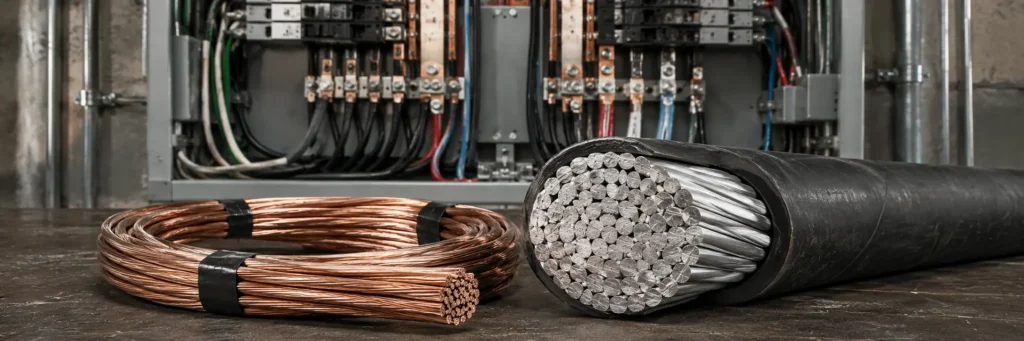
Choosing between copper and aluminum conductors comes down to cost, weight, and the electrical performance you need. This short, practical guide explains the main differences, gives a clear rule of thumb for sizing, and shows the common applications for each material. Copper vs aluminum at a glance Conductivity and sizing: Aluminum conductors have roughly 60 […]