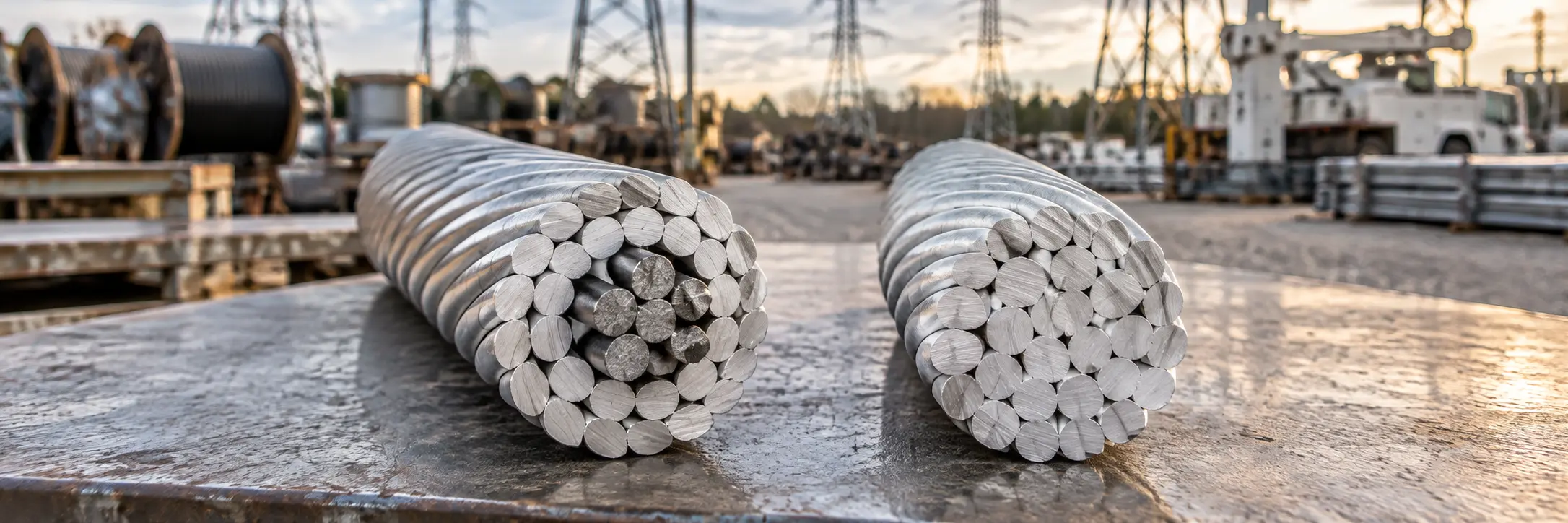
When an overhead power distribution project calls for aluminum conductor, two common options are ACSR and AAC. Both use aluminum to carry electrical current, but their construction gives them different mechanical characteristics and makes them better suited to different types of overhead installations.
Choosing between them is not simply a matter of deciding which conductor is “better.” The correct choice depends on the span length, required tensile strength, line tension, sag requirements, conductor weight, electrical capacity, environmental conditions, and the utility or engineering specification for the project.
Custom Cable Corp. supplies a broad range of aluminum cable for utility, commercial, industrial, and power distribution applications, including both AAC and ACSR constructions.
What Is AAC Aluminum Conductor?
AAC stands for All-Aluminum Conductor. As the name suggests, the conductor is made entirely from aluminum strands rather than combining aluminum with a reinforcing material.
AAC is commonly used in overhead transmission and distribution systems, as well as bus connections in substations and switchyards. It can be a good choice where conductivity, lower conductor weight, and corrosion resistance are important and the installation does not require the additional mechanical strength provided by a steel core.
Because there is no steel reinforcement, the entire conductor cross section contributes to aluminum conductivity. However, the conductor generally does not provide the same tensile strength as an equivalent ACSR design.
What Is ACSR Aluminum Conductor?
ACSR stands for Aluminum Conductor Steel Reinforced. It combines aluminum conductor strands with a steel reinforcing core.
The aluminum carries the electrical current, while the steel core provides additional mechanical strength. This construction makes ACSR especially useful for overhead transmission and distribution lines where longer spans, higher tension, or greater mechanical loading must be considered.
Custom Cable’s ACSR Aluminum Conductor, Steel Reinforced products are designed for bare overhead transmission as well as primary and secondary distribution applications. The steel core configuration can vary so the conductor construction can provide different levels of strength while maintaining the required electrical performance.
The Main Difference Is Mechanical Strength
The biggest distinction between AAC and ACSR is not simply that one contains steel. It is what that steel does for the conductor.
AAC relies entirely on aluminum strands for both electrical and mechanical performance. ACSR separates those roles more clearly, using aluminum primarily for conductivity and the steel core to increase tensile strength.
That difference can become important when designing overhead lines that must cross longer distances between supports or withstand higher mechanical loads.
When Does AAC Make More Sense?
AAC can be a strong option when the line design does not require steel reinforcement. That can include shorter distribution spans, substations, switchyards, and other overhead applications where conductor weight, electrical conductivity, and corrosion resistance are more important than maximum tensile strength.
AAC is also available in numerous conductor sizes and strand configurations, allowing the conductor to be selected according to electrical load and line design requirements. The Custom Cable All-Aluminum Cable and Tie Wire, Overhead Distribution AAC product line includes options across a wide range of AWG and MCM sizes.
When Does ACSR Make More Sense?
ACSR is commonly considered when the line needs greater mechanical strength. Longer spans can place more tension on the conductor, while wind, ice loading, support spacing, and other environmental factors can also affect the mechanical requirements of an overhead line.
The steel reinforcement in ACSR helps the conductor handle those demands while the surrounding aluminum strands provide electrical conductivity. This is one reason ACSR is widely used for overhead transmission and primary and secondary distribution systems.
ACSR vs. AAC at a Glance
| Consideration | AAC | ACSR |
| Conductor construction | Aluminum strands | Aluminum strands around a steel core |
| Primary advantage | Lightweight aluminum conductivity | Higher mechanical strength |
| Steel reinforcement | No | Yes |
| Typical applications | Distribution, substations, switchyards | Transmission and distribution |
| Longer spans | Depends on line design | Often better suited |
| Tensile strength | Lower than reinforced designs | Higher due to steel core |
| Electrical conductor material | Aluminum | Aluminum |
The final decision should always be based on the project’s electrical and mechanical requirements rather than conductor type alone.
Why Conductor Size Alone Does Not Tell the Whole Story
Two overhead conductors can appear similar when comparing AWG or kcmil size, yet perform differently because their strand arrangement, conductor construction, overall diameter, rated strength, resistance, and weight may not be the same.
This is particularly important when comparing AAC with ACSR because the steel core changes the mechanical design of the conductor. Engineers and purchasing teams should therefore compare the complete conductor specification rather than selecting one product solely because its nominal conductor size appears to match another.
Matching the Conductor to the Line Design
Before specifying an overhead aluminum conductor, it helps to confirm several project requirements, including:
- Conductor size
- Required electrical capacity
- Span length
- Required tensile strength
- Allowable sag
- Environmental loading
- Strand construction
- Utility or engineering standards
- Required footage and reel lengths
Where additional mechanical strength is required, ACSR may be the better fit. Where steel reinforcement is unnecessary, AAC may offer a simpler all-aluminum solution. Custom Cable can help identify the appropriate aluminum cable construction based on the specifications of the project.
Frequently Asked Questions
Yes. The conductor code name can identify a specific conductor size and construction and can help avoid confusion when requesting a quote.
Overhead aluminum conductors are often referenced by standardized code names in addition to AWG or kcmil size. Providing the code name can help confirm details such as strand configuration, overall diameter, rated strength, resistance, and other specifications. When requesting pricing, it is best to provide the code name along with the required footage and project specification when available.
Not necessarily. Matching nominal conductor size does not mean AAC and ACSR have identical mechanical or electrical characteristics.
The steel core in ACSR changes its construction, strength, weight, strand arrangement, and overall performance. Even when two conductors have a similar nominal size, the line design may have been engineered around a specific conductor type. Any substitution should therefore be reviewed against the required ampacity, resistance, tensile strength, sag, diameter, hardware compatibility, and applicable utility or engineering specification.
Different steel-core and strand configurations can produce different mechanical strength even when the aluminum conductor area is similar.
ACSR designs can use different numbers and sizes of aluminum and steel strands. Changing the proportion or configuration of the steel reinforcement affects tensile strength and other mechanical characteristics. This allows ACSR constructions to be selected according to the specific strength requirements of an overhead line rather than relying only on conductor size.
The most useful information includes conductor size or code name, required footage, application, span requirements, strength requirements, and the project specification.
Providing as much detail as possible reduces the chance of quoting a conductor that matches the electrical requirement but not the mechanical design. Utility specifications, drawings, existing conductor information, strand configuration, reel requirements, and required standards can also help narrow the appropriate product quickly.
Reel requirements should be considered before ordering because overhead conductor installations may require specific continuous lengths and handling limits.
Required footage should be coordinated with pole spacing, splice limitations, pulling or stringing plans, reel capacity, equipment access, and job-site handling requirements. Ordering unsuitable reel lengths can create unnecessary splices or complicate installation, so purchasing teams should confirm both conductor specifications and preferred reel quantities before the order is finalized.