Electrical cable is ultimately expected to do one basic job: deliver power where it is needed. In a mining operation, however, carrying the electrical load is only part of the challenge.
Cable may be connected to equipment that moves, vibrates, pulls, twists or operates around abrasive surfaces. It may encounter water, oils, chemicals, crushing forces and significant temperature changes. In some applications, the cable itself moves as the equipment moves.
Those conditions are why mining cable is available in so many different constructions. Selecting a cable for a mining application requires looking beyond conductor size and voltage to consider what the cable will be expected to withstand throughout its service life.
A Mining Cable Specification Starts With the Equipment
Two pieces of equipment operating at similar voltages can place very different demands on their power cables. A stationary mine load center does not place the same mechanical demands on cable as a dragline. A locomotive introduces different movement and space requirements than a crane. A portable power connection may need a different cable construction than a feeder that remains largely stationary. This is why the equipment and the way it operates should be established before narrowing the cable specification.
The question is not simply, “What voltage does this equipment use?” It is also, “What is going to happen to this cable while the equipment is operating?”
Flexibility Can Be a Performance Requirement
In a stationary electrical installation, flexibility may primarily make installation easier. In a mining or heavy industrial application, flexibility can become part of the operating requirement.
A cable connected to moving machinery may be subjected to repeated bending and flexing throughout its service life. Conductor construction, stranding, insulation, jacket construction and overall cable design can therefore become important considerations.
For example, 2000V diesel locomotive cable uses extra-flexible stranded copper and is designed for applications that can include locomotives, mining equipment, drilling rigs, motor leads and other heavy-duty flexing applications. That is a very different requirement from simply finding a conductor capable of carrying the required current.
Mechanical Stress Changes the Cable Requirement
Mining equipment does not operate in a controlled electrical room. Cable can be exposed to pulling forces, impact, abrasion, crushing and repeated movement around large equipment. The jacket and internal construction therefore need to be considered along with the electrical properties.
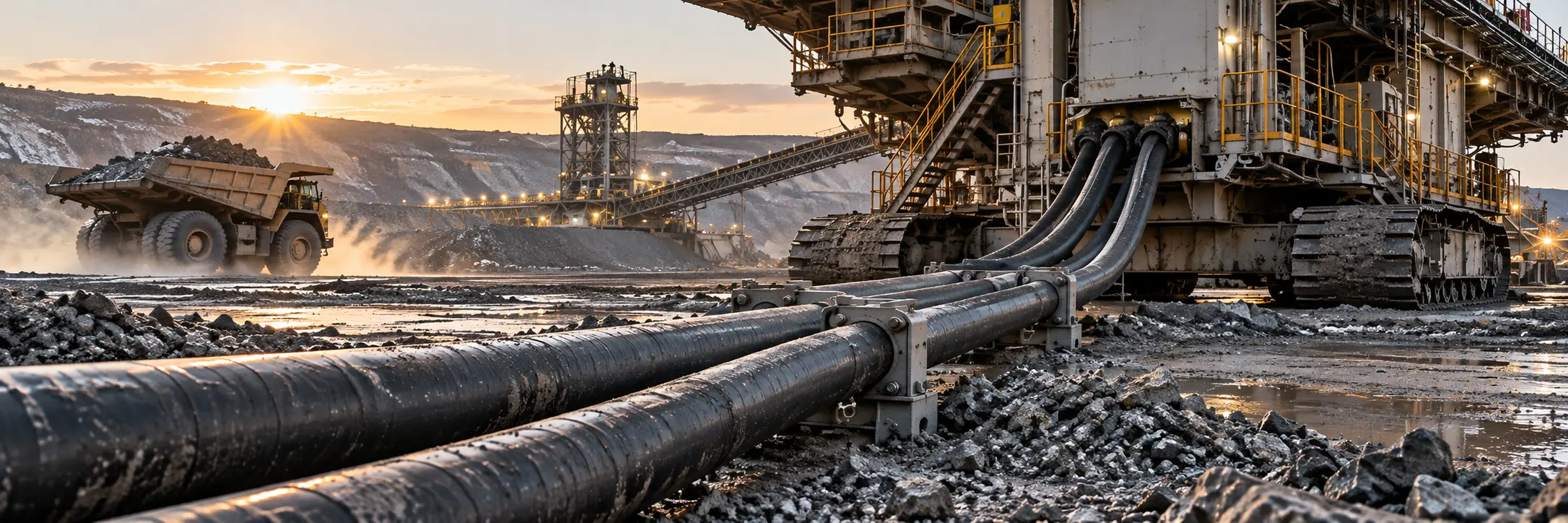
This becomes especially important with equipment such as shovels and draglines, where cable may experience significant mechanical stress while continuing to supply power.
Some mining cable constructions incorporate features specifically intended to deal with these conditions, including reinforcing materials, flexible conductors, heavy-duty jackets, shielding, grounding conductors and ground-check conductors. The result is a cable built around the operating environment, not simply the electrical load.
Grounding and Ground-Check Requirements Matter
Grounding is another reason mining cables with apparently similar electrical ratings should not automatically be treated as substitutes for one another. Certain cable constructions incorporate grounding conductors, while others may also contain a ground-check conductor used as part of a monitoring system.
Type G, G-GC and SHD-GC cable are examples of why the complete cable designation matters. These products may serve related heavy-duty power applications, but their construction and grounding arrangements are not identical.
If a project specification calls for a particular grounding or monitoring configuration, matching only conductor size and voltage will not reproduce that cable specification.
Higher Voltage Mining Equipment Introduces Additional Considerations
Mining power applications can extend well beyond 600V or 2000V portable power. Mine power feeder cable, jumper cable and shovel and dragline cable are available for higher-voltage applications, including configurations in the 5kV, 8kV and 15kV ranges.
As voltage increases, additional construction details may become relevant, including insulation thickness, shielding, grounding and the design of the complete cable system.
Mine power feeder cable is intended for a different role than a highly flexible portable power cable. It may be used to supply mine load centers and other power distribution applications where the cable installation and operating conditions differ significantly from mobile equipment.
This is another reason “mining cable” should be viewed as a family of specialized cable constructions rather than one universal product.
The Jacket Has a Job Too
The conductor receives much of the attention when cable is specified, but the outer jacket is the part of the cable directly exposed to its surroundings. In demanding environments, the jacket may need to resist combinations of abrasion, moisture, oils, chemicals, sunlight, weathering or mechanical abuse.
A cable that is electrically capable of operating the equipment can still be the wrong selection if its construction is poorly matched to the environment in which it will operate.
For equipment that is frequently moved, the relationship between flexibility and jacket durability also becomes important. A cable may need to remain manageable without sacrificing the physical protection required for demanding use.
Portable Power Is Not the Same as General-Purpose Cord
Another common source of confusion is the assumption that any flexible cable can serve a portable application. Mining and heavy industrial equipment can demand substantially more from cable than ordinary portable tools or temporary electrical equipment. Voltage, amperage, conductor configuration, movement, mechanical exposure and environmental conditions all influence the appropriate construction.
Type W single-conductor portable power cable, for example, provides a heavy-duty option for applications where individual flexible conductors are required. Other applications may call for multi-conductor Type W, Type G, G-GC or another mining cable construction. The fact that several products are flexible does not make them interchangeable.
The Best Specification Describes the Real Application
One of the most useful things a buyer can provide a cable supplier is not simply a part number. It is information about the application. That may include the equipment being powered, operating voltage, conductor size, current requirements, conductor count, grounding requirements, required approvals, environmental exposure and whether the cable will remain stationary or move during operation. Those details help narrow a very large field of cable products into constructions designed for the job.
Custom Cable Corp. supplies a broad selection of mining cable for mine power distribution, locomotives, cranes, conveyors, shovels, draglines, welding equipment, portable power and other demanding applications. When the required construction is unclear, our team can help identify cable options based on the equipment, electrical requirements and operating environment.
Frequently Asked Questions
Equipment, voltage, conductor size, conductor count, cable markings, dimensions and operating conditions can all help identify a suitable replacement.
When the original catalog number cannot be found, the remaining cable often provides useful clues. Jacket markings, conductor configuration, voltage rating, AWG or MCM size, grounding conductors, ground-check conductors and approximate outside diameter can help narrow the possibilities. Information about the equipment and how the cable is installed is equally important. A replacement should be matched to the complete application rather than selected because one or two specifications appear similar.
Yes. Cable weight can affect handling, transportation, storage and how the cable will be managed at the jobsite.
Heavy-duty mining cables can become extremely heavy over long footage. This can influence reel requirements, material handling, installation planning and the equipment needed to position the cable. Weight may also be particularly important when cable will be moved repeatedly during operation. Comparing cable weight per thousand feet along with electrical and dimensional specifications can help buyers understand the practical requirements of the complete order.
A cable can meet the electrical requirement and still create problems if its dimensions or construction do not match the intended connector or termination.
Connector compatibility can depend on more than conductor size. Conductor stranding, insulation diameter, finished cable diameter, grounding configuration and the termination design may all affect fit. When replacing an existing cable, providing information about the equipment connection or termination can help prevent a situation where the electrical specification appears correct but the cable cannot be properly connected.
They should be consulted whenever the substitution changes a specified cable type, construction, grounding arrangement, voltage class or approval requirement.
A purchasing substitution should not override an engineered system requirement. If the original specification identifies a particular cable designation, grounding system, shielding construction, industry approval or equipment requirement, changes should be reviewed by the appropriate technical authority. A cable supplier can help identify products with relevant characteristics, while the engineer, equipment manufacturer or other responsible party can determine whether the proposed substitution is acceptable for the system.
Yes. Older equipment documentation may use legacy product descriptions, manufacturer terminology or specifications that do not match the way cable is currently listed.
In these situations, identifying the electrical and mechanical requirements is often more useful than searching indefinitely for an exact old product name. Equipment documentation, cable markings, conductor size, voltage, construction details, grounding configuration and application information can help establish what the original cable was intended to do. From there, available cable constructions can be compared against those requirements rather than relying solely on the historical designation.