MV-90 and MV-105 show up on almost every medium voltage cable specification, and the two names look close enough that they are easy to treat as interchangeable. They are both Type MV cable, they come in the same voltage classes, and they can be built with the same insulation families. The difference is the temperature the conductor is allowed to reach, and that one number affects ampacity, overload margin, cost and how the cable has to be matched to the rest of the system.
This guide explains what MV-90 and MV-105 have in common, how their ratings compare, when each one is the better fit, and what to include when you request a quote for medium voltage power cable.
The Short Answer
MV-90 cable is rated for a maximum conductor temperature of 90°C (194°F) in normal operation. MV-105 cable is rated for 105°C (221°F). Both are Type MV medium voltage cable for systems from 2,001 to 35,000 volts. Because MV-105 can run hotter, it carries a higher listed ampacity than MV-90 of the same size and construction, and it has a higher emergency overload rating. MV-90 is the more common choice when the design does not need that extra thermal margin, and it often costs less.
What MV-90 and MV-105 Have in Common
Under the National Electrical Code, Type MV cable is a single or multiconductor solid dielectric insulated cable rated 2,001 volts up to and including 35,000 volts, nominal. MV-90 and MV-105 are the two temperature designations within that type.
The product standard for both is UL 1072, Medium-Voltage Power Cables. According to the UL 1072 scope published by UL Standards & Engagement, cables marked “MV-90” have a maximum operating temperature of 90°C, and cables marked “MV-105” have a maximum operating temperature of 105°C “for use where design conditions require a maximum conductor temperature above 90°C.” The same scope lists voltage ratings from 2,400 volts through 35,000 volts, covers both shielded and nonshielded designs, and covers copper or aluminum conductors.
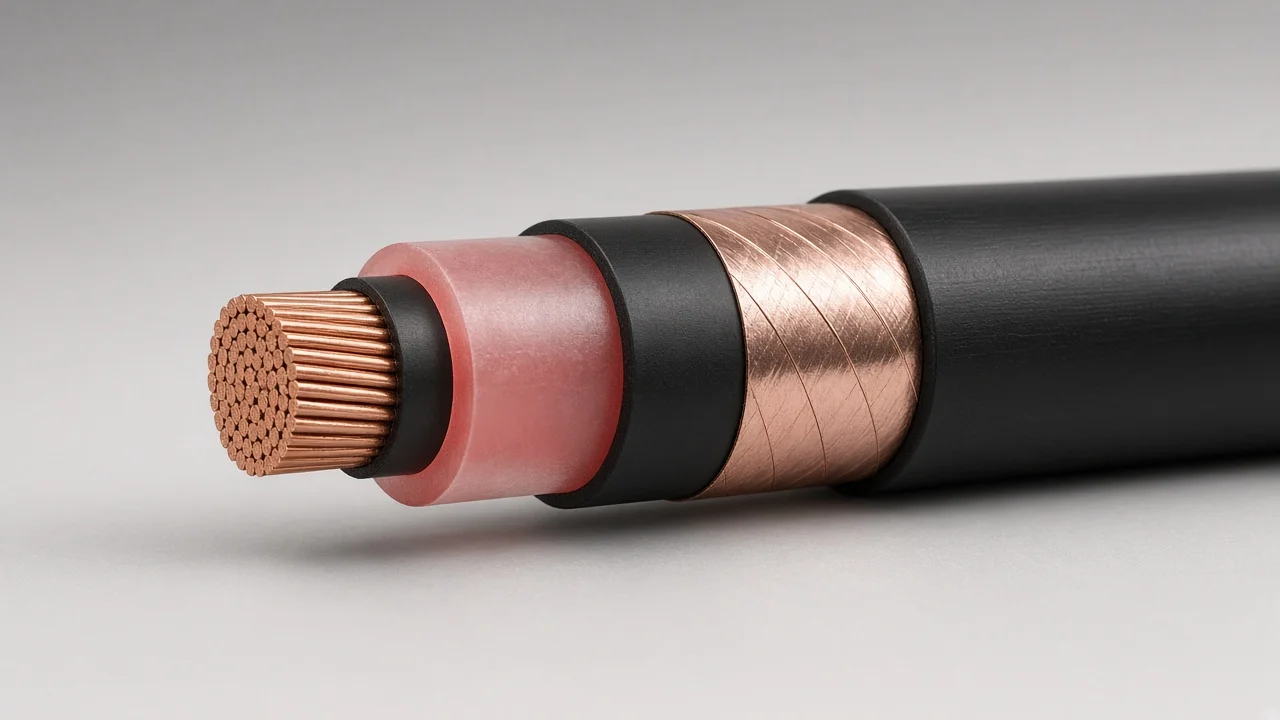
That means the voltage class, the insulation level, the conductor material, the shielding and the jacket are all separate choices from the temperature rating. A 15 kV, 133% insulation level, copper tape shielded cable can be MV-90 or MV-105. The temperature rating is one line on the specification, not a different family of cable.
MV-90 vs MV-105 at a Glance
| MV-90 | MV-105 | |
|---|---|---|
| Maximum conductor temperature, normal operation | 90°C (194°F) | 105°C (221°F) |
| Emergency overload conductor temperature | 130°C | 140°C |
| Short circuit conductor temperature | 250°C | 250°C |
| NEC cable type | Type MV, 2,001 to 35,000 V | Type MV, 2,001 to 35,000 V |
| Common voltage ratings in UL 1072 | 2,400 V through 35,000 V | 5,000 V through 35,000 V for single conductor cable |
| Insulation types | XLPE or EPR types | XLPE or EPR types rated for 105°C |
| Insulation levels | 100% or 133% at 5 kV; 100%, 133% or 173% at 8 kV and above | Same |
| Wet or dry locations | Wet or dry, or dry only when marked “MV-90 dry” | Wet or dry |
| Ampacity, same size and installation | Lower | Higher |
| Typical cost | Often lower | Often higher |
The emergency overload and short circuit figures come from ICEA S-93-639 (NEMA WC 74), the industry standard for 5 to 46 kV shielded power cable, which lists 90°C normal, 130°C emergency overload and 250°C short circuit for standard XLPE, TRXLPE and EPR insulations, and 105°C, 140°C and 250°C for the 105°C rated class of each. The same figures appear on our product pages, for example our 15 kV EPR-PVC Type MV-105 cable and our 5 kV shielded XLP Type MV-90 cable.
In UL 1072’s single conductor table, the 2,400 volt nonshielded constructions are listed only at 90°C, while 5,000 volts and up are listed at either 90°C or 105°C. So if a design calls for 2,400 volt nonshielded single conductor cable, MV-90 is the rating you will find.
What the Higher Temperature Rating Gets You
More Ampacity From the Same Conductor Size
A conductor’s ampacity is limited by how hot it can safely get. Raise the allowable temperature and the same copper or aluminum can carry more current. The NEC ampacity tables for medium voltage cable list separate columns for 90°C and 105°C conductors, and the 105°C values are higher for the same size, voltage range and installation method. As Consulting-Specifying Engineer puts it, Type MV-105 cables have a higher current carrying capacity but tend to cost more than Type MV-90 cables.
In practice, that extra capacity can let a designer stay at a smaller conductor size on a heavily loaded feeder, or keep more margin on a run that passes through a hot area.
More Room for Emergency Overloads
Medium voltage feeders sometimes have to carry more than their normal load for a period, for example when another feeder is out of service. The emergency overload rating is the conductor temperature the insulation is designed to tolerate during those conditions. MV-105 insulation is rated 10°C higher here as well, 140°C versus 130°C.
The Same Short Circuit Rating
The short circuit rating is 250°C for both. A 105°C rating does not change how much fault energy the insulation can handle. Fault withstand still comes down to the conductor size, the metallic shield and the protective devices upstream.
Insulation: Where EPR, XLPE and TRXLPE Fit
MV medium voltage cable is commonly insulated with ethylene propylene rubber (EPR) or cross-linked polyethylene (XLPE). Tree retardant XLPE, or TRXLPE, is XLPE with an additive intended to slow water treeing, a long-term form of insulation degradation driven by moisture and electrical stress.
It is a common shortcut to think of EPR as MV-105 and XLPE as MV-90. That is not a safe assumption. UL 1072 lists XLPE and EP type insulations for both temperature ratings, and ICEA S-93-639 includes a 105°C class for XLPE, TRXLPE and EPR alike. On our own medium voltage page, for example, EPR insulated cable is offered as both Type MV-90 and Type MV-105.
What decides the rating is how the specific cable is built, tested and listed, and that shows up on the jacket marking and the spec sheet. If the specification requires a particular insulation and a particular temperature rating, list both.
For more on how insulation and jacket materials affect performance, see our post on why cable jacket and insulation matter more than you think.
When to Choose MV-90
MV-90 is the right fit when:
- the engineer’s design and ampacity calculations are based on 90°C conductors
- the project specification calls for MV-90, or for a construction that is listed only at 90°C, such as 2,400 volt nonshielded single conductor cable
- the equipment, terminations and splices on the run are based on 90°C
- the load and the ambient conditions leave enough margin at 90°C
- cost matters and the extra thermal rating would not be used
MV-90 covers a wide range of commercial, industrial and utility feeder and distribution work, which is why most of the constructions identified by type on our medium voltage page carry the MV-90 rating.
When to Choose MV-105
MV-105 is worth specifying when:
- the design depends on the higher 105°C ampacity, such as a heavily loaded feeder where a larger conductor is not practical
- the cable runs through hot spaces or heavily filled raceways where heat is hard to shed
- the system needs more emergency overload margin, 140°C versus 130°C
- the project specification or the owner’s standard calls for MV-105
One caution: a 105°C cable does not raise the rating of everything it connects to. Splices, terminations and equipment have their own temperature limits, and ICEA notes that lower normal operating temperatures may be required because of the materials used in joints and terminations. The ampacity the circuit can use is set by the weakest link, so the higher rating only pays off when the rest of the system is designed for it.
What to Tell Your Supplier When Ordering
Asking for “MV-90” or “MV-105” by itself is not enough to quote the right cable. The temperature rating is one item in a full specification. When you request a quote, include:
- Temperature rating: MV-90 or MV-105, and whether a dry-only MV-90 construction is acceptable.
- Voltage rating: for example 5 kV, 8 kV, 15 kV or 35 kV.
- Insulation level: 100%, 133% or 173%. Our medium voltage power cable page explains how insulation level relates to system grounding.
- Conductor: copper or aluminum, size, and number of conductors. Our post on copper vs aluminum conductors covers that trade-off.
- Insulation type: EPR, XLPE or TRXLPE, if the specification names one.
- Shielding: shielded or nonshielded, and the shield type, such as copper tape.
- Jacket and armor: PVC, CPE or LSZH jacket, and whether interlocked armor is required.
- Installation method: conduit, duct, tray, aerial or direct burial, plus any required markings such as sunlight resistant or for CT use.
- Length: total footage and how the runs break down.
- Specification references: the project spec section and any required standards.
If any of those items is not settled yet, share what you have. For a broader checklist, see our guides on how to choose the right power cable and critical cable specifications for engineering applications. If the cable is going underground, our underground and direct burial cable guide is a good companion read.
Custom Cable Corp. supplies medium voltage cable in a range of constructions, including EPR, XLP, EPR-CPE, EPR-PVC, LSZH, shielded and unshielded designs, with Type MV-90 and Type MV-105 options from 2,400V through select 35kV cables. To get pricing on MV-90 or MV-105 cable, request a quote or call 516.334.3600, and our team can help source the right medium voltage cable for your application.
Frequently Asked Questions
Sometimes, but it is not automatic. The engineer of record should approve the change, and every other part of the specification still has to match.
An MV-105 cable meets or exceeds the temperature ratings of an MV-90 cable, but a substitution is only acceptable if the voltage rating, insulation level, conductor size and material, shielding, jacket, armor and any other required markings match the specified cable, and the construction is listed for the installation method. It is also worth confirming that the cable’s outside diameter still fits the raceway fill and that the terminations and splice kits on hand are sized for it. Because MV-105 often costs more, swapping it in only makes sense when MV-90 is unavailable or the designer wants the extra margin.
Not necessarily. The NEC allows medium voltage conductors to be terminated based on the 90°C rating and ampacity, unless the equipment is identified for a higher temperature.
Under NEC 110.40, medium voltage conductors are permitted to be terminated based on the 90°C temperature rating and ampacity in the Table 315.60(C) series, unless otherwise identified. In other words, the 105°C ampacity is only available at a termination when the equipment and termination are identified for it. Check the switchgear, transformer and termination kit ratings before counting on the higher ampacity.
It means the insulation is rated for dry locations only. Cable marked plain “MV-90” or “MV-105” is rated for both wet and dry locations.
The UL 1072 scope states that cables marked “dry” have insulation for use only in dry locations, and all other cables have insulation suitable for both wet and dry locations. A dry-only cable should not be used in underground ducts, direct burial or other locations that can be wet, even if the voltage and temperature ratings match. When comparing quotes, check the jacket legend and the spec sheet for that word.
The jacket has to be compatible with the cable’s operating temperature. Not every jacket compound is suitable for a 105°C conductor.
ICEA S-93-639 notes that not all of the jacket materials it describes are necessarily suitable for cables with the 105°C maximum temperature rating, and it directs users to the cable manufacturer. A listed MV-105 cable has been built and tested as a complete construction, so the practical step is to order a cable that is marked MV-105 as a whole, rather than assuming a jacket choice from one cable will carry over to another.
In the 2023 NEC, Type MV cable is covered by Article 315. Earlier editions placed it in Article 311 (2020) and, before that, Article 328.
According to IAEI Magazine, the 2023 NEC moved the medium voltage cable requirements from Article 311 into new Article 315, which covers the use, installation, construction specifications and ampacities of Type MV conductors, cable, cable joints and cable terminations from 2,001 to 35,000 volts ac. Product data sheets and older specifications may still reference Article 328 or Article 310, so the article number on a spec sheet does not by itself mean the cable is outdated. Your local jurisdiction decides which edition of the code applies.