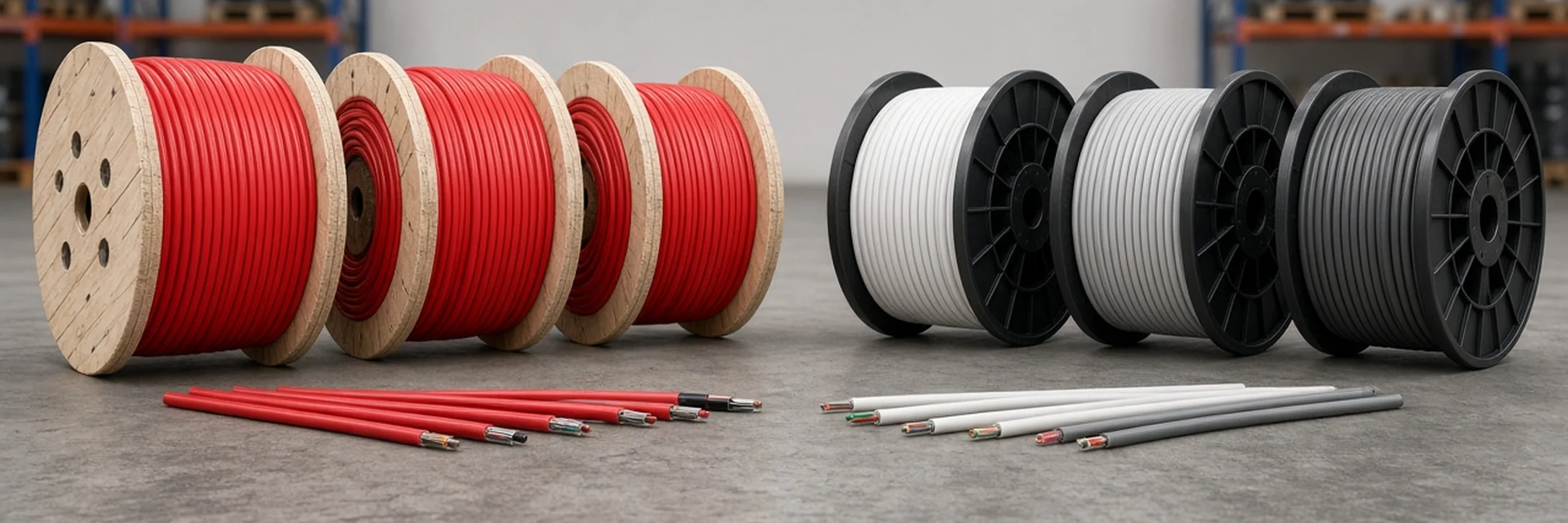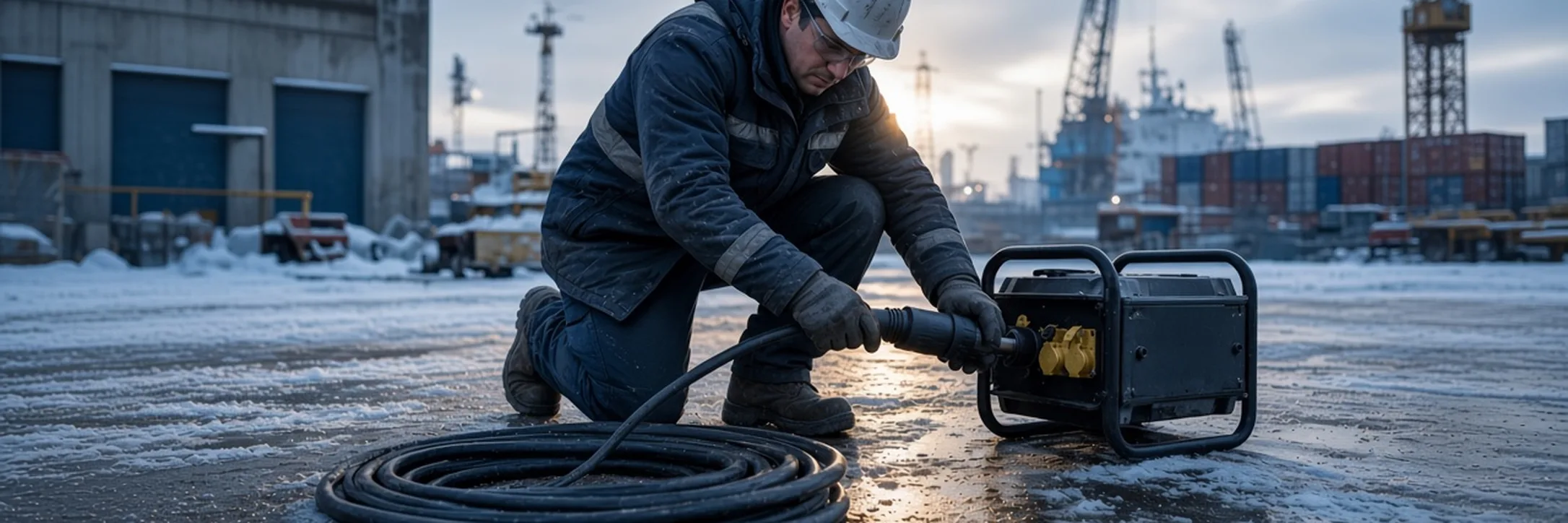
Portable cord that lives indoors has an easy life. Cord that runs across a frozen job site in January, sits in the sun on a dock all summer, or lies in a puddle of hydraulic fluid next to a pump has a much harder one. SOOW is one of the most common answers for that kind of work, and for good reason. It is still worth knowing what each part of the rating covers, where the limits are, and what to check before a cord goes back out for another season.
This guide walks through how SOOW cable handles cold, sunlight, oil, water and abrasion, the signs that a cord is ready to be replaced, and the outdoor jobs where a different cable is the better fit. For a broader look at how heat, moisture, oil and abrasion affect cable in general, see our post on cable in the real world.
What the Letters in SOOW Tell You About Outdoor Use
The letters in a flexible cord type are defined in NEC Article 400, and each one says something about where the cord can go. According to the UL Wire and Cable Application Guide, the letters break down like this:
- S stands for extra hard usage.
- O means the jacket is oil resistant. A double OO means both the jacket and the insulation are oil resistant.
- W at the end means the cord is suitable for wet locations and is sunlight resistant.
So SOOW is an extra hard usage cord with oil resistance inside and out, rated for wet locations and sunlight. That combination is why it shows up on job sites, docks, outdoor equipment and in plants. It is also why SO cable, with an oil resistant jacket only, is not always a direct swap for SOOW in an outdoor application.
The letters are only the starting point. The temperature range, voltage and approvals are printed on the jacket and listed on the spec sheet, and those details can vary from one manufacturer and construction to the next.
Cold Weather: Read the Low-Temperature Rating Before You Flex the Cord
Cold is where portable cord tends to get into trouble, because the damage often does not show up right away.
Rubber and elastomer jackets stiffen as the temperature drops. Every cord has a minimum temperature it has been tested to, which is established through cold bend testing under standards such as UL 62. Below that point, the jacket and insulation can become brittle. Extreme cold can cause cable to stiffen, crack and even break, and micro-cracking can occur that is not visible to the naked eye. Those small cracks compromise the cable and can lead to shorts once the circuit is energized.
For a portable cord, this matters more than it does for wire pulled once into a raceway. A cord is coiled, uncoiled, dragged and bent every day it is used. Flexing a cord that is colder than its rating is exactly the kind of handling that cold bend testing is meant to guard against.
How cold is too cold depends on the cord:
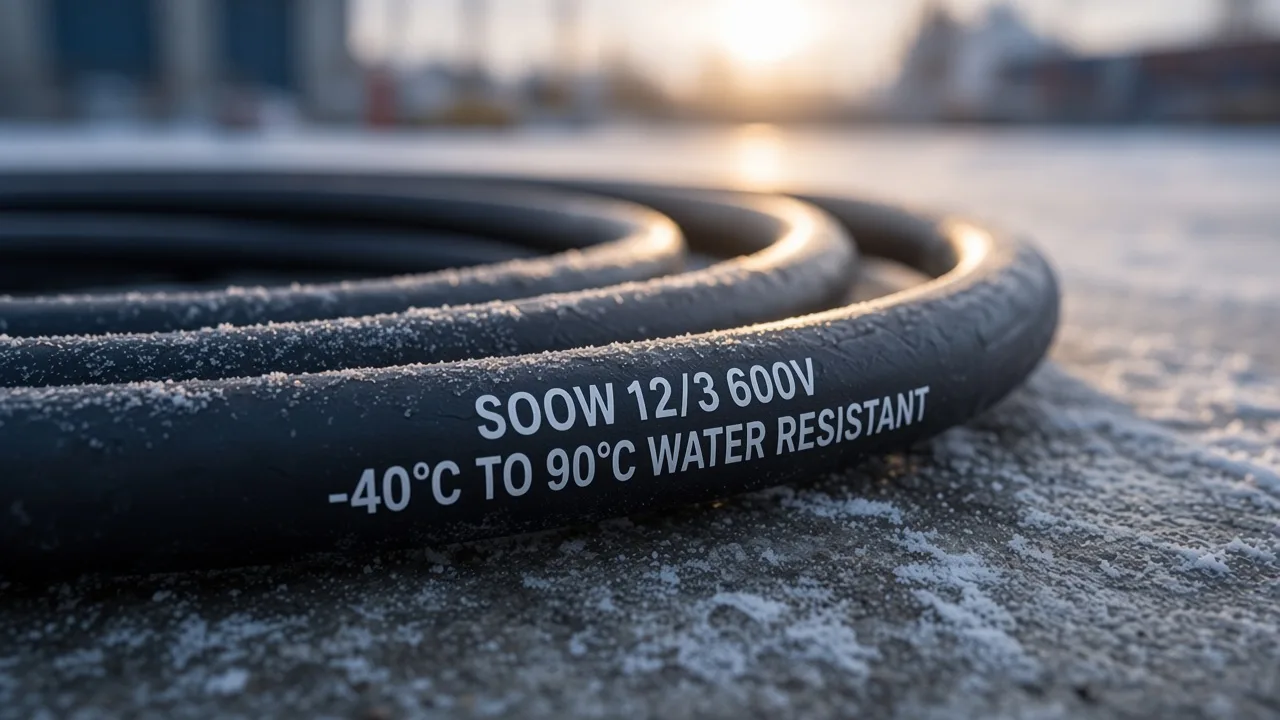
- Our Type SOOW 600V cord in sizes 18/2 through 2/5 lists a temperature range of -40°C to +90°C (-40°F to 194°F).
- Some spec sheets list only the maximum conductor temperature. Our multiconductor SOOW page, for example, gives a 90°C rating without a low-temperature figure.
Because the low end of the range is not the same on every product, check the jacket print and the manufacturer’s spec sheet for the exact cord you are buying. Do not assume every SOOW carries the same cold rating.
A few cold weather habits help a cord last:
- Store cord somewhere warm before a cold job, and give a frozen coil time to warm up before you uncoil it.
- Uncoil slowly, and avoid sharp bends and kinks at the plug and connector.
- Do not try to straighten a stiff, frozen cord by force or by stepping on it.
- After the job, look for cracking at the bends and near the fittings before the cord goes back on the truck.
Sun and Weather: What the W Covers
The W suffix is the part of the rating that covers sunlight. The UL Wire and Cable Application Guide explains that a flexible cord evaluated for outdoor use carries a W in its type designation, and that cords with the W suffix are suitable for wet locations and are sunlight resistant. UL also notes that sunlight resistance means the outer covering has been evaluated for direct exposure to ultraviolet radiation from the sun.
That is an important difference from cord without the W. A cord that is perfectly suitable indoors may not have been evaluated for long-term UV exposure. On a dock, a rooftop or an outdoor equipment yard, the W is what you want to see.
Sunlight resistant does not mean the jacket will last forever in the sun. Heat is part of the picture too. The ampacities in NEC Table 400.5(A) are based on an ambient temperature of no more than 86°F, as EC&M points out in its overview of NEC flexible cord requirements. A cord lying on hot pavement or a steel deck in full summer sun is often working in a hotter ambient than that, which is worth considering when you size cord for a long outdoor run.
Oil: Why OO Matters and Why Oil Still Shortens Cord Life
Oil is one of the fastest ways to ruin a cord that is not built for it. Oil attacks a jacket compound in two ways. When the compound absorbs oil, it swells and softens and loses tensile strength. When oil pulls the plasticizer out of the compound, the material hardens and loses its flexibility. More exposure, more frequent exposure and higher temperatures all speed up the damage.
That is why the double O in SOOW matters around engines, pumps, hydraulic equipment and machinery. With SOOW, both the jacket and the conductor insulation are oil resistant, so oil that gets past a nick in the jacket does not meet an unprotected insulation layer.
Oil resistant is still not the same as oil proof. UL marking practice shows that oil resistance is tested at set temperatures. According to the UL guide, a cord marked “OIL RES I” has been evaluated at 60°C and one marked “OIL RES II” at 75°C. A cord that sits in hot oil every day, or in a chemical it was never tested against, can still swell, soften or crack over time. If a cord will be soaked in a specific fluid, check that fluid against the manufacturer’s data before you order.
Water and Wet Locations
The W in SOOW means the cord is suitable for wet locations. Our SOOW cord pages describe the construction as water resistant.
A wet location rating covers rain, snow, washdown and cord lying in wet areas. It is not the same thing as a rating for direct burial or for use as submersible pump cable. UL treats direct burial and submersible pump use as separate evaluations in its marking guide, so a wet location rating alone does not cover them. If a run needs to go in the ground, look at direct burial cable instead of burying portable cord.
Water also finds its way in at the ends. Plugs, connectors and cord grips are often the weak point on an outdoor run, so use fittings suited to wet locations and keep connections off the ground where you can.
Abrasion and Physical Damage
Extra hard usage cord is built to be dragged across concrete, gravel and steel. Our SOOW cord pages list excellent abrasion resistance and a heavy-duty thermosetting jacket. Even so, abrasion is the slow killer on most job sites. A jacket that wears thin in one spot is a jacket that will let water, oil and cold do their work faster.
The NEC sets a firm limit here. Section 400.12 does not permit flexible cords where they are subject to physical damage. Cord run across a driveway, a forklift aisle or a walkway needs to be protected or rerouted, not just left in place because the jacket is tough.
Practical habits that reduce wear include:
- Using cord protectors or ramps where vehicles and foot traffic cross the run.
- Keeping cord away from sharp edges, pinch points and hot surfaces.
- Using proper strain relief at plugs and equipment. NEC 400.14 requires cords to be connected so that tension is not transmitted to joints or terminals.
- Not dragging a long run by the plug.
Signs an Outdoor Cord Should Be Replaced
Outdoor cord rarely fails all at once. It usually tells you something is wrong first. Take a cord out of service and have it checked or replaced if you see:
- Cracks or splits in the jacket, especially at bends, near the plug and on the outside of coils that were handled in the cold.
- A jacket that feels hard or stiff at normal temperatures, or one that has gone soft, swollen or tacky where it has been in oil.
- Exposed insulation or conductors, or a jacket worn thin enough that the inner layers show through.
- Flattened, pinched or crushed sections, which can mean internal damage even when the outside looks intact.
- Damage at the ends, such as cracked plugs, bent or missing pins, loose strain relief or a jacket pulling back out of the connector.
- Heat damage, such as discoloration or a burnt smell at a plug, connector or one section of the run.
When in doubt, replace the cord. The cost of a new length of cord is small compared with the cost of a shock, a fire or a piece of equipment that goes down mid-job.
Storage and Handling Between Jobs
A good share of cord life is decided between jobs:
- Coil it loosely. Tight wraps and kinks put stress on the jacket and conductors. Follow the manufacturer’s minimum bend radius.
- Clean it before storage. Wipe off oil, grease, mud and salt rather than letting them sit on the jacket for weeks.
- Store it dry and out of the weather when you can. Being sunlight resistant does not mean a reel needs to sit in the sun all season.
- Keep heavy loads off it. Do not store cord under equipment or materials that can crush it.
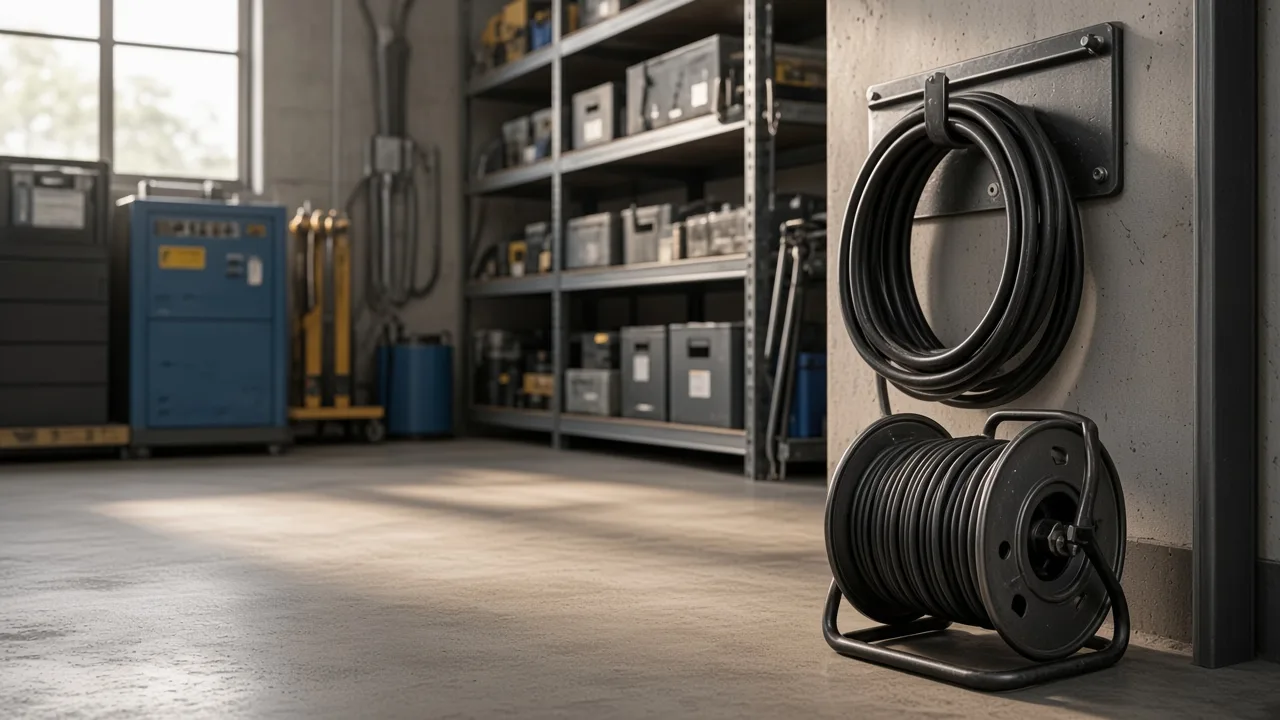
- Hang or reel long runs. A cord reel or proper hanger keeps a long length from tangling and from being bent at sharp angles.
- Label and inspect. Marking cords by length and condition makes it easier to pull a damaged cord before it goes back out.
When an Outdoor Job Needs Something Other Than SOOW
SOOW covers a lot of outdoor work, but it is not the right cable for every job:
- Colder than the rating. If the work runs below the cold rating on the SOOW you are using, check the temperature range on the spec sheet before the job and call our team to match a cord to the conditions.
- Higher voltage or heavy mobile equipment. Larger mobile equipment and higher voltages often call for heavier portable power cable. Our team can help you choose the right cable for the load.
- Mining and ground check circuits. Mining machines and equipment that needs ground check monitoring use dedicated mining cable. Our post on why mining cable has to do more than carry power covers the types.
- Buried runs. As noted above, use cable rated for direct burial.
- Permanent installations. NEC 400.12 does not permit flexible cord as a substitute for fixed wiring, through walls, ceilings or floors, or attached to building surfaces except where specifically allowed. A run that has become permanent should be replaced with a fixed wiring method.
If you are not sure whether a job calls for SOOW or something heavier, our post on flexible power cable that has to survive the job looks at the cost of putting the wrong cord in service.
Ordering SOOW Cable for Outdoor Work
When you request a quote for outdoor cord, it helps to share the conductor size and count, the length, the voltage, and the conditions the cord will see: the lowest expected temperature, sun exposure, oil or chemical contact, and how often it will be moved. That information makes it easier to confirm the cord’s ratings fit the job before it ships.
Custom Cable Corp. supplies SOOW cable and a full range of portable cord. To get pricing on SOOW cable for outdoor work, request a quote or call 516.334.3600, and our team can help match the cord to your application.
Frequently Asked Questions
Before use on every shift. OSHA requires a visual check of portable cord and cord sets for external defects and signs of internal damage before each shift.
Under OSHA 1910.334, flexible cord sets must be visually inspected before use on any shift for external defects, such as loose parts, deformed or missing pins, or damage to the jacket or insulation, and for evidence of internal damage, such as a pinched or crushed jacket. Cords that stay connected once in place and are not exposed to damage do not need to be inspected again until they are relocated. If a defect could expose someone to injury, the cord has to be removed from service until it has been repaired and tested.
Sometimes, but only for larger sizes and only with a proper splice. Many applications require cord to be used in continuous lengths without splices.
The OSHA construction standard 1926.405 says flexible cords shall be used only in continuous lengths without splice or tap, but hard service cords No. 12 or larger may be repaired if the splice keeps the insulation, outer sheath properties and usage characteristics of the original cord. The NEC also requires cords to be installed without splices or taps in the applications listed in Section 400.10(A). Electrical tape over a cut jacket does not meet that standard, so for smaller cords, or where a proper splice is not practical, replacing the length is the safer choice.
Generally, no. The NEC lists running flexible cord through doorways, windows and similar openings among the uses that are not permitted.
NEC Section 400.12 prohibits flexible cords from being run through doorways, windows or similar openings unless the use is specifically permitted in Section 400.10, as summarized by EC&M. A cord closed in a door or window is also exposed to crushing, which is one of the damage types an inspection is meant to catch. If equipment outside needs power on a regular basis, an outdoor receptacle or another code-compliant wiring method is the better answer.
At a minimum, the cord type, conductor size and number of conductors. Most manufacturers also print the voltage, temperature range and approvals.
OSHA’s construction standard requires hard service cord types such as S and SO to be durably marked with the type designation, size and number of conductors. A typical SOOW jacket legend goes further and often includes the voltage, the temperature range, a water resistant marking and UL, CSA and MSHA listings. If the legend has worn off and you cannot confirm what a cord is, that is a good reason to retire it from outdoor service.
It means the cable design has passed the Mine Safety and Health Administration’s flame resistance requirements. Approved cable carries an MSHA approval number printed along its length.
MSHA approval for electric cable falls under 30 CFR Part 7, Subpart K, which sets flame resistance requirements for electric cables, signaling cables and splice kits. Approved cables must be marked at intervals of no more than 3 feet with the MSHA-assigned approval number, the number and size of conductors, the cable type and the voltage rating. MSHA approval addresses flame resistance. It does not by itself make a cord the right choice for every piece of mining equipment, so check the mine’s requirements and the equipment manufacturer’s specification as well.