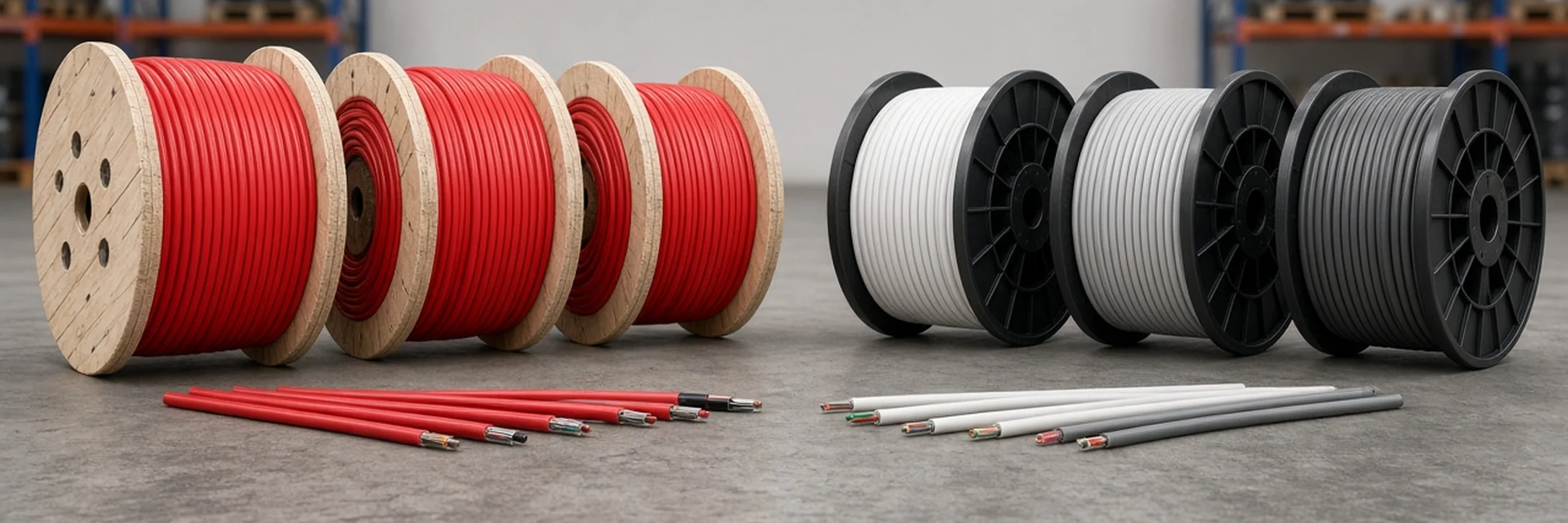
A red jacket and an FPLP marking can make two reels of fire alarm cable look nearly identical. On a New York City job, they may not be interchangeable. NYC-approved fire alarm cable is built and listed to additional city requirements that standard FPLP cable is not required to meet.
The difference between standard FPLP and NYC-approved cable comes down to construction minimums, the listing behind the cable and the legend printed on the jacket. Knowing what to look for before cable is ordered, submitted or delivered can prevent a failed inspection and a costly pull-out.
What Is Standard FPLP and FPLR Cable?
FPLP, FPLR and FPL are the three types of power-limited fire alarm cable covered by UL 1424, the standard for cables used on power-limited fire alarm circuits. The letters describe where each type is intended to go: FPLP is plenum cable, FPLR is riser cable and FPL is for general use outside plenums and risers.1
Each type is tested differently. FPLP cable intended for ducts, plenums and other air-handling spaces is tested for flame travel and smoke under NFPA 262. FPLR cable intended for vertical runs in shafts, or for runs that pass through more than one floor, is tested for flame propagation height under UL 1666.1
Those ratings tell you how the cable behaves in a fire. They do not, by themselves, tell you whether the cable meets New York City’s added requirements.
What Makes Fire Alarm Cable NYC-Certified?
New York City has set its own requirements for fire alarm cable for decades. A 1995 NYC Department of Buildings policy notice on accepting fire alarm cables for use in the city lists the basic characteristics:
- A minimum temperature rating of 150°C
- A minimum average insulation thickness of 15 mils
- A minimum average jacket thickness of 25 mils
- A red cable
- Type FPLP (plenum type) construction
- External marking showing that the cable meets these requirements and is listed by UL2
A Department of Buildings rule on fire alarm wiring, 1 RCNY §4000-06, carries the same requirements forward and spells out the jacket legend. Cable marked under UL 1424 must also carry the description “ALSO CLASSIFIED NYC CERT. FIRE ALARM CABLE,” legible without removing the jacket.3
The same rule also states that substitutions of Type FPLP or NYC-certified fire alarm cable are not permitted.3 The rule refers to the 2008 edition of the National Electrical Code, so confirm the current requirements with the NYC Electrical Code in effect for your permit and with the engineer of record.
Standard FPLP vs. NYC-Certified FPLP Side by Side
The table below summarizes the main differences. Treat the NYC column as a checklist to confirm against the current code and the project specification, not as a substitute for either.
| Feature | Standard UL FPLP | NYC-Certified FPLP |
|---|---|---|
| Listing | UL 1424, Type FPLP | UL 1424, Type FPLP, plus NYC classification |
| Insulation thickness | Varies by product | 15 mils minimum average |
| Temperature rating | Varies by product | 150°C minimum |
| Jacket | Color and thickness vary by manufacturer | Red, 25 mils minimum average |
| Jacket legend | UL 1424 type marking | UL 1424 marking plus “ALSO CLASSIFIED NYC CERT. FIRE ALARM CABLE” |
| Shielding | Optional | Optional, based on system design |
How to Tell the Two Apart
The jacket legend is the most direct check. Standard FPLP cable will carry its type marking. NYC-certified cable should carry that marking plus the NYC classification printed on the jacket.
Jacket color is not proof. Red is the usual color for fire alarm cable, but manufacturers can make standard fire alarm cable in other colors, and a red FPLP cable without the NYC legend is still a standard FPLP cable.4
The product data sheet should match what is printed on the cable. Check that the type, conductor size, pair count, insulation thickness, jacket thickness and temperature rating on the submittal agree with the reel that arrives. For a broader look at the specifications engineers check before approving cable, see our guide to critical cable specifications for engineering applications.
The listing itself can be confirmed with the organization that certified the cable. If the jacket print, data sheet and listing do not agree, resolve it before the cable is pulled.
Where Plenum and Riser Ratings Fit on NYC Jobs
On most jobs outside the city, the plenum or riser choice follows the space: plenum cable for air-handling spaces, riser cable for shafts and floor-to-floor runs. If you want more background on how plenum ratings work across cable families, our post on tray cable vs. plenum cable covers the basics.
New York City takes a narrower approach. Where the national code calls for Type FPLR, the DOB fire alarm wiring rule replaces it with Type FPLP NYC-certified fire alarm cable.3 That means a riser run on an NYC job may call for the same plenum-rated, NYC-certified cable used elsewhere in the building.
This is why requests for “NYC shielded FPLR” deserve a second look. If a specification or submittal names an FPLR cable for an NYC fire alarm system, confirm with the engineer of record and the authority having jurisdiction before ordering.
Where Shielding Fits
The DOB requirements listed above cover cable type, insulation, temperature, jacket color and marking. They do not list shielding.2
NYC shielded FPLP is typically chosen because the fire alarm equipment manufacturer or the system design calls for it. Shielding helps protect signaling circuits from electrical noise when cable runs near motors, drives, transformers or power conductors. UL 1424 allows a cable with one or more shields to be surface marked as “shielded,” which helps identify it on site.1
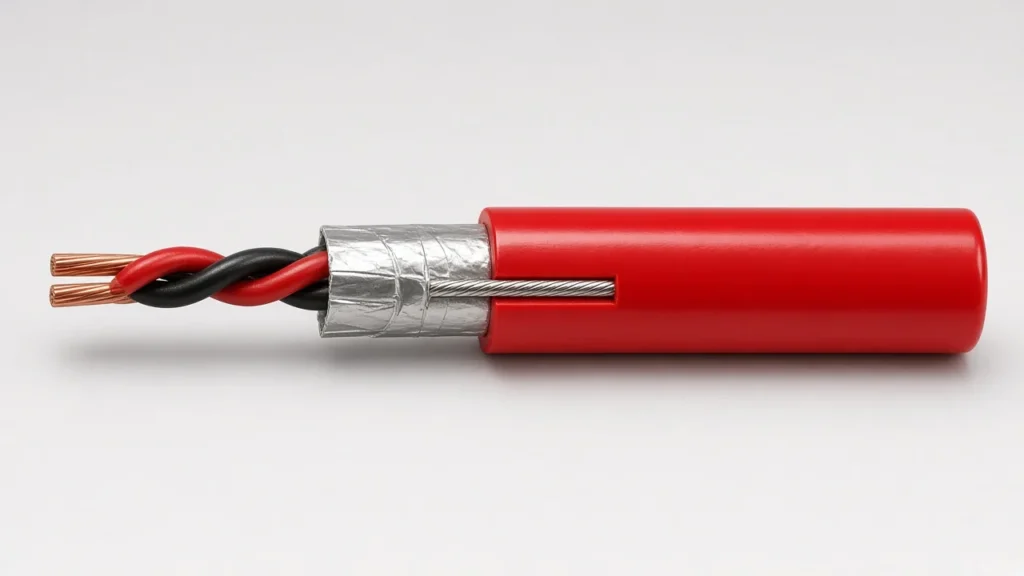
Custom Cable Corp. stocks NYC Certified Type FPLP shielded fire alarm cable in 12 through 18 AWG with one, two or three pair constructions, depending on gauge. The cable uses solid bare copper conductors, color-coded fluorocopolymer insulation, a 100% aluminum/polyester foil shield with a stranded tinned copper drain wire and a red fluorocopolymer jacket rated to 150°C, packaged on 1,000 ft spools.5
What Goes Wrong When the Wrong Cable Shows Up on Site
The most common problem is simple: standard FPLP arrives instead of NYC-certified FPLP. The cable may be plenum rated and red, but without the NYC classification and legend it does not meet the city’s requirements.
If that cable is installed, an inspector reading the jacket can reject the work. Correcting it usually means pulling the cable out, ordering compliant cable and reinstalling, which adds labor and can push back the fire alarm acceptance test and other trades that depend on it.
Mismatched submittals cause a second set of problems. When the approved submittal names one product and a different cable is delivered, the change may need to go back through review, even if the new cable is NYC-certified. Shielded and unshielded constructions are a frequent source of this mismatch.
Gauge and pair count are a third risk. A cable can carry the correct NYC classification and still be wrong for the circuit if the conductor size does not support the voltage drop calculation or the pair count does not match the device wiring.
Sourcing UL-Listed Fire Alarm Cable for NYC Work
When buyers ask where contractors can source UL-listed fire alarm cable for New York City projects, the useful answer is a supplier that can confirm the listing, the NYC classification and the exact construction before the order ships. A quote request goes faster when it includes:
- Cable type and NYC certification requirement
- Shielded or unshielded construction
- Conductor size and number of pairs
- Footage and spool requirements
- Project specification section or submittal reference
- Required delivery date
Custom Cable Corp. is a New York wire and cable supplier based in Westbury, Long Island. If you are specifying or buying fire alarm cable for an NYC project, request a quote on our NYC-certified FPLP shielded fire alarm cable or call 516.334.3600, and our team can help match the cable to your specification.
Frequently Asked Questions
Often, yes, because it is still a UL-listed Type FPLP cable. Whether it is acceptable on a given job depends on the local code and the project specification.
Contractors who work on both sides of the city line sometimes standardize on NYC-certified cable to simplify inventory. Before using leftover city stock on another job, check the specification for anything else it calls for, such as a named manufacturer, a shielded or unshielded construction or a different jacket color, and confirm the local authority accepts it.
The city’s minimums for temperature rating, insulation thickness and jacket thickness push manufacturers toward higher-performance materials. Those materials, plus the added certification and marking, typically raise the price per foot.
Our NYC-certified cable, for example, uses fluorocopolymer insulation and a fluorocopolymer jacket to reach its 150°C rating, and fluoropolymer compounds typically cost more than the PVC used in many standard cables. When comparing quotes, make sure every option on the table carries the NYC classification, since a lower price on standard FPLP is not a like-for-like comparison.
At a minimum, include the manufacturer’s data sheet and a description of the jacket print for each cable. Many reviewers also expect the listing information and a clear statement of the NYC classification.
A complete submittal makes it easy for the reviewer to match the cable to the circuit schedule. List each cable by part number, conductor size, pair count and shielding, and note where each one will be used. If the fire alarm equipment manufacturer recommends specific cable characteristics, such as shielding or a capacitance limit, show that the proposed cable meets them. Keeping a copy of the approved submittal on site helps the crew check deliveries against it.
It can be, as long as every cable meets the project specification and the equipment manufacturer’s requirements. Problems usually come from mixing constructions, not brands.
Two NYC-certified cables of the same gauge from different manufacturers may still differ in shielding, capacitance or diameter. On circuits where the panel manufacturer limits total capacitance or calls for a specific shielding approach, those differences matter. If more than one brand is on the job, keep each circuit consistent and make sure the submittal covers every product that will be installed.
As early as the submittal is approved. Stock of specific gauge, pair count and shield combinations can vary, so confirming availability early helps keep the fire alarm rough-in on schedule.
Standard FPLP is widely stocked, but city-specific constructions in a particular configuration may not always be on the shelf. Sharing the full cable schedule with your supplier at the start, rather than ordering reel by reel, gives the supplier time to confirm each item and flag any substitutions that would need approval before they become a problem on site.
Sources
- “UL 1424: Cables for Power-Limited Fire-Alarm Circuits,” UL Standards & Engagement. https://www.shopulstandards.com/ProductDetail.aspx?productId=UL1424_5_S_20241008
- “Technical Policy and Procedure Notice #2/95: Acceptance of Fire Alarm Cables for Use in New York City,” NYC Department of Buildings. https://www.nyc.gov/assets/buildings/ppn/tppn295.pdf
- “1 RCNY §4000-06: Fire Alarm Wiring and Power Sources,” NYC Department of Buildings. Cable marked under UL 1424 “must bear additional description ‘ALSO CLASSIFIED NYC CERT. FIRE ALARM CABLE’ legible without removing jacket.” https://www.nyc.gov/html/dob/downloads/rules/1_RCNY_4000-06.pdf
- “Fire Alarm Cables Product Guide,” West Penn Wire. Jacket color: “Normally red, but can be any color.” https://www.westpennwire.com/pdf/18375-FireAlarm-Product-Guide.pdf
- “NYC Certified Fire Alarm Cable, Type (UL) FPLP Power Limited Fire Protective Signal Shielded Plenum,” Custom Cable Corp. https://www.customwireandcable.com/product-category/plenum-cable/nyc-certified-fire-alarm-cable-type-ul-fplp-power-limited-fire-protective-signal-shielded-plenum/